
Best Food Processor Blender Combo 2026: One Base for Smoothies and Chopping
When you buy through the Amazon links on this page, we may earn a commission at no extra cost to you. Learn more
Last updated October 30, 2026
The Ninja Mega Kitchen System BL770 is the best all-round food processor blender combo for most cooks: one 1500-watt base drives a 72 oz crushing pitcher, two 16 oz cups and an 8-cup processor bowl with a dough blade rated for 2 lb of dough. A combo works because one motor and one cord serve both jobs, and it falls short because the two halves are never equally capable: the jar blends better than the bowl, and the bowl chops better than the jar.
This page is for cooks who want smoothies and chopping from one counter footprint, and who want to know which half of a combo they are really paying for.
The best food processor blender combos for 2026
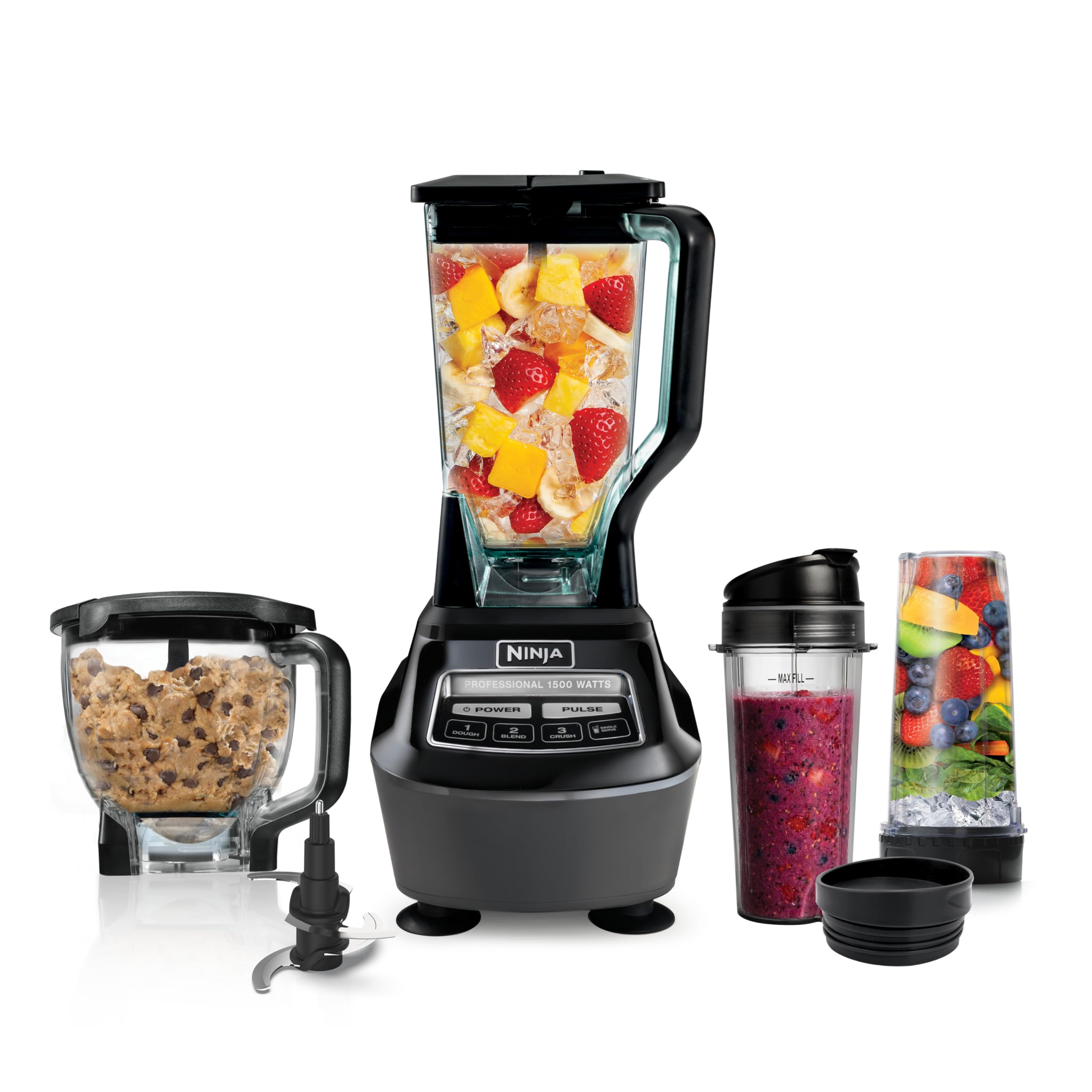
Ninja Mega Kitchen System BL770
See on Amazon
Ninja Professional Plus BN801
See on Amazon
Ninja AMZ493BRN compact kitchen system
See on AmazonModel comparison
| Model | Price | Rating | Weight | Pitcher capacity | Best for | |
|---|---|---|---|---|---|---|
| | Ninja Mega Kitchen System BL770 | $179.99 as of 10/31 See on Amazon | ★ 4.7 (43,200+ ratings) | 9.2 lb | 72 oz | One-appliance households short on counter space get an 8-cup bowl plus a 72-oz pitcher and two 16-oz cups. |
| | Ninja Professional Plus BN801 | $159.99 as of 10/31 See on Amazon | ★ 4.7 (14,800+ ratings) | 8.8 lb | 72 oz | Busy cooks who want one-touch programs and bigger single-serve cups get five Auto-iQ presets, two 24 oz cups and a 64 oz chopping bowl. |
| | Ninja AMZ493BRN compact kitchen system | $179.99 as of 10/31 See on Amazon | ★ 4.8 (8,300+ ratings) | 11.1 lb | 72 oz | Small-kitchen owners and single-serve users get a 17.25 in tall base with a 40 oz processor bowl and dough blade. |
 | Ninja Foodi SS401 power blender & processor | $259.95 as of 10/31 See on Amazon | ★ 4.6 (4,000+ ratings) | 12.1 lb | 72 oz | Small-batch nut butter makers who want preset programs get an 18-oz smoothie bowl maker with built-in tamper and Auto-iQ spreads settings. |
 | Hamilton Beach 58163J | $79.99 as of 10/31 See on Amazon | ★ 4.2 (4,800+ ratings) | 7.7 lb | not stated | Small kitchens needing smoothies and light chopping get a 40 oz glass jar, travel jar and 3-cup chopping bowl. |
What a combo machine actually is and how the two functions share one base
A combo pairs a tall blender jar and a food processor bowl on a single motor base, and the base drives each attachment in a different way. A blender wants high blade speed in a narrow vessel so liquid climbs the walls and falls back into the blade. A processor wants torque, the turning force that pushes an S-blade through dense food, turns a dough blade through stiff flour and spins a slicing disc against a carrot.
One motor has to serve both, so the two functions are never equally strong on the same machine. A combo can be an excellent blender and an average processor, or the reverse, so judge each half on its own job.
How a combo is built
One base with a blender jar and a separate processor bowl that both lock onto the same drive, sometimes with single-serve cups added, is the most common layout. A second layout starts from a blender base and adds a processor attachment that sits on the same coupling, which means the same principle with a different parts count. A third puts the processing inside the pitcher itself, with a special lid and discs, so no separate bowl exists at all; that saves a part but leaves a wide vessel that handles small batches poorly.
Why the shared motor sets the ceiling
Torque and speed pull in opposite directions. A motor geared for blade speed loses some of the low-end force a dough blade needs, and a motor tuned for torque can leave a smoothie less silky than a dedicated blender's. That is why the processor half of a combo is usually the compromise, and why the bowl's size and its discs tell you more about a combo than its wattage does.
What each attachment on a combo base is built to do, and which one to reach for first
The jar owns wet, high-speed work: smoothies, milkshakes, pureed soups, emulsified dressings, crushed ice and nut butters made with a tamper. The bowl owns dry and structured work: chopped onions and nuts, minced herbs and garlic, sliced cucumbers and potatoes, shredded cheese and carrots, kneaded dough.
The shapes explain the split. A jar is tall and narrow with a small, fast blade at the bottom, which keeps the food moving in a column. A bowl is wide and shallow with a broad S-blade, and on some models with discs mounted on a stem that throw sliced food out against the wall.
Stop asking one attachment to do the other's job
A processor bowl makes gritty smoothies, because leafy greens and frozen fruit sit under the blade instead of being pulled through it. A blender jar turns vegetables to mush instead of slicing them, because a spinning blade at the bottom cannot cut a cucumber into even rounds. Match the job to the attachment and both halves feel capable.
Slicing and shredding only exist if there are discs
A bowl with just a chopping blade and a dough blade cannot slice or shred at all, whatever the motor size. Discs are the line between a chopper and a true food processor, and a single reversible disc gives you one slice thickness and one shred size, not a choice of several.
Why the blender jar usually outperforms the processor bowl for smoothies
Smoothie quality comes from a vortex. The tall, tapered jar pulls frozen fruit and leafy greens down into a fast-spinning blade, and the mixture keeps circulating until it is smooth. A wide, low bowl cannot form that vortex, so fibrous greens and ice sit at the bottom and stall the blade.
Blade speed and blade geometry matter more than wattage alone. A jar with stacked or hybrid blades, and a tamper where the model provides one, handles frozen whole fruit and ice; a bowl's S-blade does not, and ice should never go into the processor bowl in the first place.
When a smoothie disappoints, look at the jar and the fill level
The cause is usually the jar or how full it is, not the base. Fill within the marked maximum, pour the liquid in first so the blade has something to pull the solids into, and use the tamper where the model has one. A jar loaded to the top with frozen fruit and no liquid will stall on almost any motor.
A strong jar with a modest bowl is a valid buy
The reverse also holds. A combo with a good jar and a plain chopping bowl is a good smoothie machine that chops adequately, which suits a lot of buyers better than a balanced machine that excels at neither.
Switching between jar and bowl and what that means for daily use
Every change of function means lifting one attachment off, seating the other, and re-checking the lid and the interlock before the motor will run. Some models also want the right program or speed range for the attachment in place, so the swap is not quite as quick as it looks on the box.
You cannot blend and chop at the same time. A soup that needs a chopped garnish means blending, decanting, swapping to the bowl, chopping, then cleaning both. That rhythm suits cooks who batch: one smoothie session, one prep session, one dough session. It frustrates cooks who alternate constantly inside a single recipe.
Cleaning adds up with every part
Count the jar, the lid, the bowl, the bowl lid, the blades and any discs. Most parts are dishwasher safe on the top rack, but gaskets and disc stems are best hand-washed, and the blades are sharp enough to warrant care when you unload them.
The parts you are not using need a home
Whatever is not on the base has to go somewhere. Open the cabinet you plan to use and count the pieces before you buy, because a combo with three containers and four blades takes up more shelf room than the single base suggests.
Where a combo saves space and where it does not
A combo saves a motor and a power cord, and it saves counter space compared with two separate machines sitting side by side. That is the real gain, and it is a big one in a small kitchen.
It does not save much cabinet space. The jar, the bowl, the lids, the blades and the discs all still need storing, and a combo can end up taking more shelf room than two standalone appliances because of the extra parts.
Measure height and depth before anything else
Check the space under the upper cabinets and the depth of the counter. A tall base with the jar fitted can be the tallest thing on the counter, and a deep base pushes the jar back under the cabinet. Both numbers are on the spec sheet, so use them.
Weight matters if you move it
Anyone who lifts the base to store it or to wipe under it should check the weight. A heavy base with a full jar is awkward to shift, and the same base is easier to leave in place and wipe around.
When two separate machines make more sense than a combo
Heavy daily smoothie use alongside frequent slicing and shredding is the clearest case for two machines. A dedicated blender and a dedicated processor each do their job without compromise, and each can run while the other is in use, which a shared base can never do.
Regular bread baking is another. A standalone processor with a dough blade and a large bowl kneads more dough, more consistently, than a shared base, and it does not ask the motor to switch roles between loaves.
Large batches and fine slicing
Bowls on combos top out well below the biggest standalone processor bowls, so a household prepping several pounds of vegetables at once will feel the limit. Wanting several slice thicknesses or julienne is the other deal-breaker: combos typically offer one reversible disc, which is one slice thickness and one shred size.
Cooking for one or two
A large combo bowl leaves small quantities rolling around the base, where the blade misses them. A compact combo with a small bowl, or a small standalone processor, works better for a single onion or a handful of herbs.
Frame the decision as a question of habits, not quality. A combo is the right buy when you use each job occasionally and rarely at the same time; two machines win when both jobs are frequent and demanding.
Our picks by budget
The Hamilton Beach 58163J is the budget pick because it delivers real blending plus basic chopping from one base, with a glass jar that resists staining and heat and a three-year warranty, and it is honest about being a blender with a chopper rather than a full combo.
The Ninja Mega Kitchen System BL770 is the mid-range pick because it is where a genuine processor bowl appears: an 8-cup bowl with chopping and dough blades, a 72 oz crushing pitcher and two cups, with enough motor to crush ice and knead 2 lb of dough.
The Ninja Foodi SS401 power blender & processor is the premium pick because the processor half gains discs and the blender half gains control: a feed-chute lid with slicing, shredding and grating discs, a dough blade, a built-in tamper and one-touch programs, with no second bowl to store.
Budget
Mid-range
High-end
Which combo fits which cook
The right combo follows from which half you lean on most, the jar for smoothies or the bowl for prep.
Smoothie-first household that also chops
A 72 oz pitcher, two 16 oz cups, an 8-cup bowl and a dough blade cover blending, chopping and kneading from one base, at family capacity.
Cook who wants to slice and shred
It brings a reversible slicing/shredding disc and a grating disc, plus presets and a built-in tamper for frozen fruit and nut butters.
Buyer who wants one-touch programs
Five Auto-iQ programs, a 72 oz pitcher, two 24 oz cups and an 8-cup bowl with a dough blade, with no discs if slicing is not on your list.
Small kitchen, single servings, light chopping
At 17.25 in tall, 8.25 in wide and 7.5 in deep it still brings a 72 oz pitcher, an 18 oz cup and a 40 oz processor bowl with a dough blade.
First combo on a tight budget
A glass jar, a travel jar and a 3-cup chopper on one base, and no discs or dough blade to expect.
Our verdict on the best food processor blender combos
The Ninja Mega Kitchen System BL770 is the best all-round combo because it does all blending, chopping and dough at family capacity. The Ninja Foodi SS401 power blender & processor is the pick for anyone who wants slicing and shredding, with a feed-chute lid and select-cut discs. The Ninja Professional Plus BN801 suits preset-driven users, the Ninja AMZ493BRN compact kitchen system is the compact choice, and the Hamilton Beach 58163J is the budget entry with a glass jar. One caveat decides the purchase: check for discs and check the bowl size before anything else.
Detailed model analysis
A combo earns its place on the counter only when both halves pull their weight, so each one is judged on the bowl first and the jar second.
Ninja Mega Kitchen System BL770
The Ninja Mega Kitchen System BL770 puts a 1500-watt motor base under a 72 oz pitcher, an 8-cup processor bowl and two 16 oz cups. One base covers smoothies, chopping and single servings.
The pitcher holds up to 64 oz of liquid. Its Total Crushing Blades crush ice to snow, which helps with frozen fruit drinks. The cups have To-Go lids, so you can blend a drink and carry it out the door.
The bowl has a chopping blade and a dough blade. The dough blade mixes up to 2 lb of dough in 30 seconds. Four blades come in the box, including Pro Extractor Blades for the cups.
Cups, bowls, blades and lids can go in the dishwasher, top rack recommended. The motor base only gets wiped with a damp cloth.
It is tall and wide, so it needs real counter space. Its 16 oz cups are the smallest of the five. The Ninja Professional Plus BN801 and the Ninja Foodi SS401 both offer bigger cups.
It suits cooks who want one base for large smoothie batches, chopping and dough, and who have the counter room to leave it out.
- Brand: Ninja
- Power: 1500 W
- Pitcher capacity: 72 oz
- Food processor bowl: 8 cups
- Weight: 9.2 lb
- Dimensions: 15.75 in deep, 11.1 in wide and 18.07 in high
Ninja Professional Plus BN801
The Ninja Professional Plus BN801 is built for cooks who want the machine to manage timing. It offers five Auto-iQ presets: smoothies, frozen drinks, nutrient extractions, chopped mixtures and dough.
Each preset combines timed pulsing, blending and pausing. You press one button and walk away.
Power is rated at 1400 peak watts. The 72 oz pitcher holds up to 64 oz of liquid, and Total Crushing Blades handle ice for frozen drinks.
The processor bowl holds 8 cups, which is 64 oz. It comes with a chopping blade and a dough blade, and the base mixes up to 2 lb of dough in as little as 30 seconds.
The two single-serve cups hold 24 oz each and have spout lids. The unit weighs 8.8 lb, and a 30-recipe guide is included.
The limits are modest: it has only 3 speeds, and the warranty is one year. It suits busy cooks who like preset programs.
- Brand: Ninja
- Pitcher capacity: 72 oz
- Processor bowl capacity: 64 oz
- Single-serve cups: 2 x 24 oz
- Preset programs: 5
- Weight: 8.8 lb
Ninja AMZ493BRN compact kitchen system
The Ninja AMZ493BRN suits small-kitchen owners and single-serve users who want a slim base, smoothies and moderate chopping. It is slim and compact on the counter.
The 72 oz pitcher holds up to 64 oz of liquid. A 1200-watt base drives a Stacked Blade Assembly for ice and frozen ingredients. Auto-iQ programs blend for you, and pulse and adjustable time give you control.
The food processing side is smaller. The bowl holds 40 oz, or 5 cups, with a chopping blade and a dough blade. The Ninja Mega Kitchen System BL770 and the Ninja Professional Plus BN801 both have 8-cup bowls.
The single-serve cup holds 18 oz and takes Pro Extractor Blades. A spout lid lets you carry your drink out. You get one cup, not two.
The pitcher has a pour spout for smoothies and sauces. Parts are plastic and BPA free, and the blades are stainless steel.
Do not expect it to be light. It weighs 11.1 lb, versus 9.2 lb for the Ninja Mega Kitchen System BL770 and 8.8 lb for the Ninja Professional Plus BN801.
- Brand: Ninja
- Power: 1200 W
- Pitcher capacity: 72 oz
- Processor bowl capacity: 40 oz
- Weight: 11.1 lb
- Dimensions: 7.5 in deep, 8.25 in wide and 17.25 in high
Ninja Foodi SS401 power blender & processor
The Ninja Foodi SS401 skips the separate processor bowl. A feed chute lid and discs handle slicing, shredding and grating, which suits shredded carrots, coleslaw or grated cheese.
The Reversible Slicing/Shredding Disc and the Grating Disc come with a dough blade and a 2-part pusher.
Power is the highest of the group, with 1600 peak watts and 1200 watts nominal. smartTORQUE helps it keep going through thick, frozen mixes.
The 18 oz XL Smoothie Bowl Maker has a built-in tamper for frozen fruit with less liquid, or nuts and seeds for nut butter. Seven Auto-iQ programs and variable speed control are included.
The Nutrient Extraction Cup holds 24 oz and the pitcher holds 72 oz. Containers, lids, discs and blade assemblies are dishwasher safe.
The trade-off is weight: it is the heaviest of the five at 12.1 lb. It suits nut butter makers and shredders who want presets and strong power.
- Brand: Ninja
- Pitcher capacity: 72 oz
- Peak motor power: 1600 W
- Voltage: 120 V
- Weight: 12.1 lb
- Dimensions: 8.7 in deep, 8.3 in wide and 16.14 in high
Hamilton Beach 58163J
The Hamilton Beach 58163J weighs 7.7 lb. Its 40 oz glass jar handles extreme temperatures, so you can blend ice-cold smoothies and hot liquids. The lid has a no-mess pour spout that also works for streaming in oil.
A 20 oz travel jar lets you blend and go. A 3-cup chopper attachment slices, shreds and chops vegetables for salsa and similar jobs.
You get 12 blending functions, including pulse, on push buttons. The Wave~Action system pulls the mixture down into the blades. Jars, lids and blades are dishwasher safe, and the cord stores in the base.
Power is 700 peak watts. The 3-cup chopper is well under the 8-cup bowls on the Ninja Mega Kitchen System BL770 and the Ninja Professional Plus BN801.
The three-year warranty compares with one year on those two Ninja models. This model suits small kitchens needing smoothies and light chopping without a heavy base.
- Brand: Hamilton Beach
- Peak power: 700 W
- Voltage: 120 V
- Number of speeds: 12
- Blending jar capacity: 40 oz
- Weight: 7.7 lb
Frequently asked questions
Most doubts about combos come down to which attachment does which job and what the shared motor gives up.
Is a food processor blender combo worth it?
It is worth it when you want smoothies and chopping from one base and one counter footprint, and you accept that the two halves are not equally strong. It is not worth it if you need heavy slicing, large batches or frequent dough.
What are the disadvantages of a combo?
You can only use one function at a time, you swap and re-seat attachments between jobs, the processor bowl is usually smaller and less equipped than a standalone processor's, and the extra parts still need storage.
How much power does a combo need?
Enough to crush ice and turn a thick puree; the models here run from 700 peak watts at the budget end to 1500 watts at the top. Wattage alone does not decide smoothie quality, since jar shape and blade design do.
Can I blend a smoothie and then chop vegetables in the same session without washing anything in between?
You can, but you have to swap attachments and clean as you go. The jar and the bowl are separate pieces that each lock onto the same base, so you lift the jar off, seat the bowl, and re-check the lid and interlock before the motor will run. Nothing is shared between the two containers, so the bowl starts clean, but the jar, its lid and the blade still need washing afterward, and you cannot run both jobs at once.
Can a combo crush ice?
Yes if the jar and blades are designed for it, so look for a crushing pitcher and stacked or hybrid blades. Do not crush ice in the processor bowl.
Is a combo better than buying a blender and food processor separately?
A combo wins on counter space and on buying one motor. Go separate when you need several slice thicknesses or julienne, or when you bake bread regularly and want a large bowl that kneads without switching roles.
Will a combo replace both machines in my kitchen?
It replaces both for occasional use of each. If you blend daily and prep vegetables in quantity, keep or buy a dedicated processor.