
Best Dicing Food Processor 2026: Even Cubes Without Picking Up a Knife
When you buy through the Amazon links on this page, we may earn a commission at no extra cost to you. Learn more
Last updated October 30, 2026
The Breville BFP838 Paradice 16 is the best dicing food processor for 2026 because it ships with three dicing discs (8, 12 and 16 mm), so you pick the cube size your dish needs instead of accepting one. Only machines with a dedicated dicing kit, a slicing disc plus a fixed grid, produce cubes; a standard S-blade chops whatever falls onto it and never gives you squares.
The Breville BFP638 Paradice 9 is the sensible everyday choice if one 0.5-inch cube size is enough, and the WantJoin WZQPJK86001BKUS01 is the low-cost way in if your dicing is root vegetables. A dicing kit pays off on batches, not on a single onion.
The best dicing food processors of 2026

Breville BFP838 Paradice 16
See on Amazon
Breville BFP638 Paradice 9
See on Amazon
Anatole CFP-1 Vegetable Dicer
See on AmazonModel comparison
| Model | Price | Rating | Power | Voltage | Weight | Best for | |
|---|---|---|---|---|---|---|---|
| | Breville BFP838 Paradice 16 | $699.95 as of 10/31 See on Amazon | ★ 4.4 (100+ ratings) | 1450 W | 120 V | 16.9 lb | Volume dicers and entertainers get 8 mm, 12 mm and 16 mm dicing discs plus a 1450 watt motor in a 16-cup bowl. |
| | Breville BFP638 Paradice 9 | $399.95 as of 10/31 See on Amazon | ★ 4.2 (100+ ratings) | 625 W | 120 V | not stated | Small-kitchen cooks who dice regularly and need one cube size get an included 0.5 inch dicing kit in a 9-cup bowl. |
| | Anatole CFP-1 Vegetable Dicer | $189.99 as of 10/31 See on Amazon | ★ 4.0 (50+ ratings) | 100 W | 110 V | not stated | Cooks and small food businesses dicing firm vegetables in bulk get three stainless-steel cube sizes and 20 to 30 minutes of continuous running. |
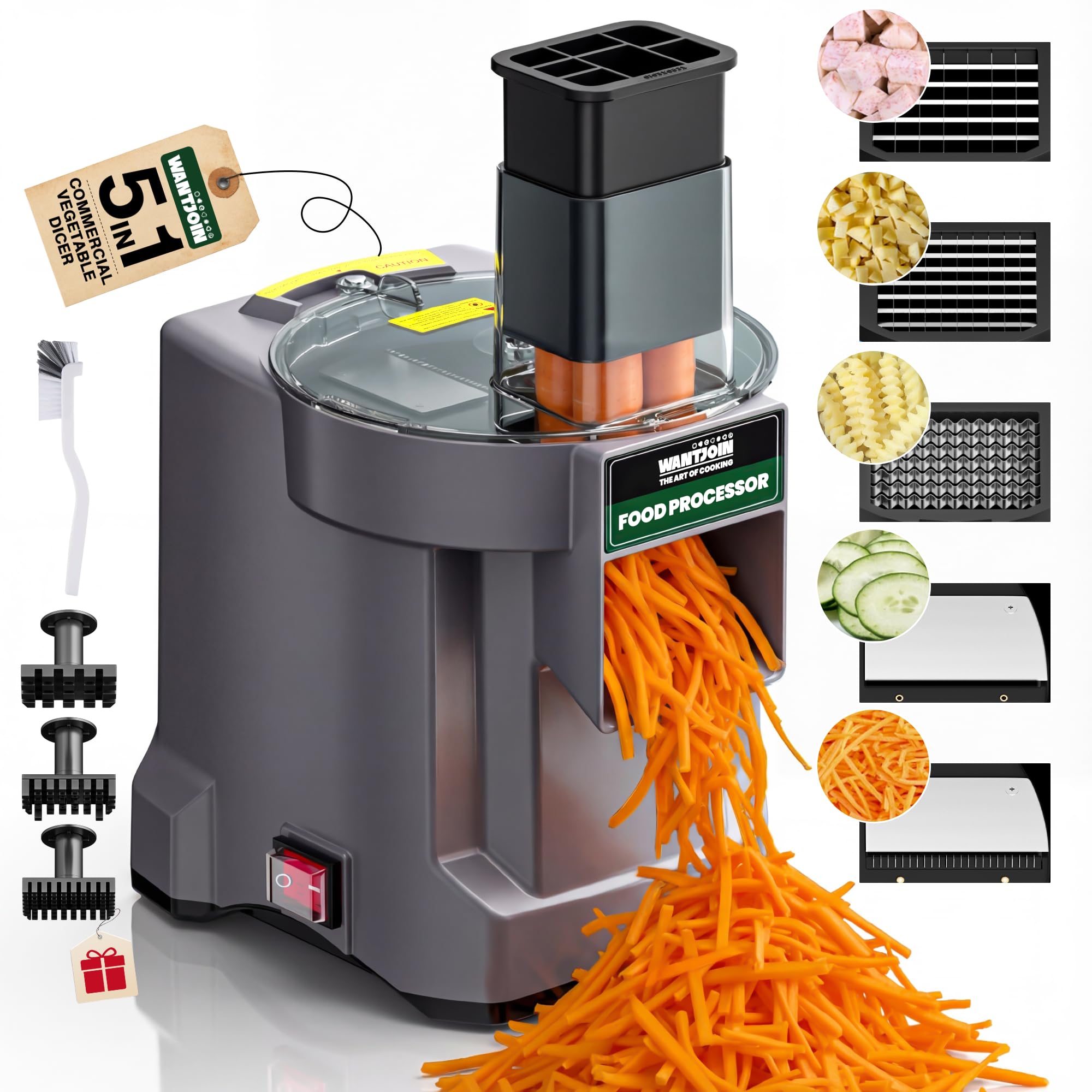 | WantJoin WZQPJK86001BKUS01 vegetable chopper | $139.99 as of 10/31 See on Amazon | ★ 4.5 (8 ratings) | 100 W | 110 V | 8.8 lb | First-time dicer buyers on a small kitchen budget get 8/12mm cubes and 2.5mm slices from one-touch thickened 420 stainless steel blades. |
What dicing actually means on a food processor
A horizontal slicing disc spins at the top of the bowl and cuts a flat slice off whatever you push down the feed tube. That slice is then forced through a fixed grid of square blades sitting just below the disc, and what comes out the other side is a cube. The grid does the cubing; the disc only makes the slice that feeds it.
This is why the grid, not the blade and not the speed, sets the cube size. Push harder and the cubes come out the same size, just faster. Change the grid and the cube changes.
The S-blade works on a completely different principle. It sits at the bottom of the bowl and cuts whatever falls onto it, from constantly changing angles, so pieces near the blade get hit again and again while pieces at the top barely get touched. Pulsing evens that out a little, but it never produces squares, because nothing in the bowl is holding the food to a shape. A listing that says a machine dices means a grid is included. A machine without one cannot dice, whatever its wattage.
Why diced cubes come out uneven and how to fix it
Ragged dice almost always come from how the food met the grid, not from the machine. The grid only cuts cleanly when a piece passes through it straight, in one movement, with its full face against the blades.
The four causes
- Overfilling the feed tube. Food rides up instead of moving down, so pieces meet the grid at an angle and get torn rather than cut.
- Forcing soft or oversized pieces. A piece that does not fit gets squashed against the grid until it gives, and the cut face is crushed.
- Feeding at an angle. A piece dropped in sideways hits the grid corner-first and breaks into odd shapes.
- Pushing unevenly or too fast. A jolt drives one side of the piece through before the other, and the cube comes out wedge-shaped.
The loading technique
Cut food to fit the tube with a little room to spare, then pack the pieces upright and snug against one side of the tube so they cannot tumble on the way down. Use the pusher with steady, even pressure and let the machine do the work at its own pace. Keep the tube no more than loosely filled: a few pieces at a time beats a stuffed chute every time.
Expect the last few slices of any batch not to pass through the grid. They sit on top of it, and you finish them with the cleaning cap or by hand. That is how the mechanism works, not a fault in the machine.
Which foods a dicing disc handles well and which it cannot
Firm raw vegetables and fruit dice cleanly: potatoes, carrots, onions, peppers, cucumbers, zucchini and apples all pass the grid and come out as cubes. Cooked and cooled potatoes work too, because chilling firms up the starch.
Soft items smear. Ripe tomatoes, avocado and mushrooms crush against the grid instead of cutting, and you end up with wet pulp on the blades. Fibrous items such as leeks tear along the fibers rather than cubing. Frozen food and meat are out entirely: they either stall the grid or bend it. Some owner's manuals specify a lower speed for very soft produce, which helps a little but does not turn a tomato into a cube.
The practical rule is simple. If a knife would squash it rather than cut it, the grid will too. Check the food with your chef's knife before it goes anywhere near the feed tube.
Dicing disc sizes and the cube dimensions they produce
Dicing discs come in fixed sizes, measured in fractions of an inch or millimeters: roughly 5/16 in (8 mm), 3/8 in (10 mm), 1/2 in (12 mm) and 5/8 in (16 mm). The size is set by the disc and cannot be adjusted. Changing the cube means changing the disc, and not every machine offers more than one.
Match the size to the dish rather than to personal taste:
- Small dice, around 5/16 in (8 mm), for salsa, sofrito, tartare and salads where the pieces should disappear into the mix.
- Medium dice, around 3/8 to 1/2 in (10 to 12 mm), for soups, stews, curries and roasting trays, the everyday size most recipes assume.
- Large dice, around 5/8 in (16 mm), for chunky soups, gratins and fries-style cuts where you want to see the vegetable.
A machine with a single grid locks you into one cube size for every dish you make. That is fine if your cooking runs to soups and stews, and frustrating the first time a recipe asks for a small dice.
Feed tube shape and size for clean dicing
When you dice, the feed tube is doing a job it does not do when you slice: it has to hold food upright and aligned all the way down to the grid. A wide, tall tube with a snug pusher does that. A loose or short tube lets pieces tilt and tumble, and a tilted piece meets the grid at an angle and comes out ragged.
Narrow tubes limit what can be diced at all. A whole onion or a large potato has to be halved or quartered before it fits, which adds prep time and partly cancels the speed advantage of dicing in the first place. The wider the tube, the less pre-cutting you do.
A 3-in-1 or 2-in-1 chute with a removable inner tube gives you both: a wide opening for big items and a narrow one for slim ones like carrots and celery, where a narrow tube actually keeps the piece steadier. Check the tube's dimensions before you buy, because it decides how much knife work happens before the machine starts.
Keeping diced pieces from turning mushy or bruised
Compression and tearing are what leave diced cubes wet or crushed. A clean cut leaves a dry, sharp face; a piece forced through the grid leaves a bruised one that leaks water into the bowl.
Cut food to fit the tube before dicing, so the grid does the work in a single pass instead of grinding a piece down. Work in small batches rather than filling the bowl and the tube at once. Process soft items at a lower speed, or skip the grid for them entirely. Empty the bowl promptly, because pieces sitting in their own liquid go soft within minutes.
A sharp, clean grid cuts rather than crushes. Starchy items leave a film on the blades that makes the next piece drag, so clean the grid between batches of potatoes or squash with the cleaning tool. Never put your fingers near the grid: the blades are sharp on both faces and the tool exists for exactly this.
Our picks by budget
The WantJoin WZQPJK86001BKUS01 is our budget pick because it delivers two dicing sizes and a slicing disc in a compact 8.8 lb body, which is the cheapest route to real cubes as long as your food is firm.
The Breville BFP638 Paradice 9 is our mid-range pick because it pairs a 0.5-inch dicing kit with a full slicer, shredder and dough blade set, and stores all of it inside the bowl, so the dicing kit does not become a drawer orphan.
The Breville BFP838 Paradice 16 is our premium pick because its three dicing discs, 16-cup bowl, 5.5-inch 3-in-1 chute and 1,450 W induction motor are what let you match the cube to the dish and dice in quantity.
Budget
Mid-range
High-end
Which dicing machine fits your kitchen
The right dicing machine depends on how much you prep at once and whether one cube size covers the dishes you cook.
Small kitchens and occasional dicing
The WantJoin takes up little counter space, gives you two cube sizes and asks for little commitment. Accept that it is built for hard vegetables and not for soft produce.
Everyday cooking with one cube size
The Paradice 9 covers the medium dice that soups, stews and roasting trays call for, and every attachment stores inside the bowl. If 12 mm is enough for your cooking, this is the machine.
Batch cooking and meal prep
The Paradice 16 holds 16 cups and gives you three cube sizes, so a week of prep in one session does not lock you into one dice. The induction motor keeps up when the tube is full.
Volume dicing of firm vegetables
The Anatole CFP-1 runs 20 to 30 minutes continuously and turns out a potato in about 10 seconds, with three cube sizes and cleaning tools for the grids. It is a dicer, not an all-round processor.
Our verdict on the best dicing food processors
The Breville BFP638 Paradice 9 is the dicing machine most homes should buy: one 0.5 in (12 mm) grid that covers soups, stews and roasting, a full slicer and shredder set, and storage inside the bowl. Step up to the Breville BFP838 Paradice 16 if you dice in volume or need to choose between 5/16 in (8 mm), 1/2 in (12 mm) and 5/8 in (16 mm) cubes, and take the WantJoin WZQPJK86001BKUS01 as the low-cost entry if your dicing is root vegetables and you accept that soft produce is out. Whichever you pick, a dicing kit earns its place on batches, not on a single onion, and the last few slices of every batch still need a hand.
Detailed model analysis
A dicing kit is only as good as the grid it puts in front of your food, and the grid decides the cube size you live with.
Breville BFP838 Paradice 16
The Breville BFP838 Paradice 16 offers three cube sizes with 8 mm, 12 mm and 16 mm dicing discs. It suits anyone who wants even cubes without a knife.
Each disc slices the food, then a grid cuts the slices into cubes. A dicing distributor and a dicing gearbox come in the box, so you change cube size by swapping discs.
Its direct drive induction motor is rated at 1450 watts, and the bowl holds 16 cups. Big batches of onions, carrots or potatoes fit without constant emptying.
A 3-in-1 feed chute runs from 1.7 in to 5.5 in, so large pieces need less pre-cutting. A 24-size adjustable slicer, a French fries disk, a shredding disk and a dough blade cover other prep.
The limits are practical: a single speed only, and a weight of 16.9 lb, so plan a permanent spot. The bowl is BPA-free plastic and the unit is dishwasher safe.
A 2-year limited product warranty and a 30-year motor warranty back it. It suits cooks who dice in volume.
- Brand: Breville
- Bowl capacity: 16 cups
- Power: 1450 W
- Voltage: 120 V
- Weight: 16.9 lb
- Dishwasher safe: Yes
Breville BFP638 Paradice 9
The Breville BFP638 Paradice 9 is built for one job: clean 0.5 in cubes. Its Paradice kit pairs a half grid with a blade system, and the 4.7 in chute lets many vegetables go in with little trimming.
Storage is the other strength. An onboard caddy holds the dicing kit, S-blade, reversible shredder, adjustable slicer and dough blade inside the bowl. Color coding helps you find each accessory quickly.
The bowl holds 9 cups and the motor is rated at 625 watts. It has two speeds, while the Breville BFP838 Paradice 16 has a single speed. The shredder offers coarse and fine grades.
Against the Breville BFP838 Paradice 16, you get only one dice size instead of three, a 9-cup bowl instead of 16 cups, and 15 slicer levels instead of 24.
It weighs 15.5 lb. The bowl and lid are dishwasher safe, with a 2-year limited product warranty and a 30-year motor warranty. It suits small-kitchen cooks who dice often and need one cube size.
- Brand: Breville
- Capacity: 9 cups
- Power: 625 W
- Voltage: 120 V
- Speeds: 2
- Dimensions: 11.8 in deep, 7.7 in wide and 17.5 in high
Anatole CFP-1 Vegetable Dicer
The Anatole CFP-1 is an electric cuber for firm vegetables, with three stainless steel dicing blades. It suits cooks and small food businesses that dice in bulk and want three fixed cube sizes.
Speed is the point. It cuts a potato in about 10 seconds and can run 20 to 30 minutes continuously, which suits big piles of potatoes, carrots, onions or cucumbers.
An enlarged feed opening and a one-touch switch keep the work simple. Direct discharge sends the cubes out so they do not build up inside. Strong heat dissipation helps it keep running.
An electromagnetic induction device stops it from starting unless the cover is secured. A food pusher and protective gloves come in the box.
Cleaning is covered too, with a tool made for the grid blades and three brushes included.
Know the limits. It is not for soft food. The motor is rated at 100 W on 110 V, and it does one job with three fixed blade sizes.
- Brand: Anatole
- Power: 100 W
- Voltage: 110 V
- Blade material: Stainless steel
- Number of blades: 3
- Power source: Corded electric
WantJoin WZQPJK86001BKUS01 vegetable chopper
The WantJoin WZQPJK86001BKUS01 is a 5-in-1 chopper and dicer with several cube sizes, 2.5 mm slices and thickened 420 stainless steel blades. Thickness is adjustable.
A one-touch switch starts the 100 W motor, which turns at 4000 RPM. A wide feed chute takes whole ingredients, so you cut less by hand first.
Anti-skid suction cups keep the base steady on the counter. At 8.8 lb, it is lighter than the Breville BFP638 Paradice 9 at 15.5 lb and the Breville BFP838 Paradice 16 at 16.9 lb.
It works best on hard vegetables, and it is listed for root vegetables, onions and citrus fruits. It is not meant for soft produce like tomatoes.
It is hand wash only. Rinse the blades right after use and skip abrasive scrubbers. A cleaning brush and blade cleaners are included, and technical support lasts one year.
We see it suiting first-time dicers on a small kitchen budget who mostly cut root vegetables and onions.
- Brand: WantJoin
- Power: 100 W
- Voltage: 110 V
- Motor speed: 4000 RPM
- Weight: 8.8 lb
- Blade material: Stainless steel
Frequently asked questions
Most dicing disappointments trace back to soft produce, an overloaded feed tube or a grid that was never cleaned between batches.
Can a food processor actually dice?
Only when a dicing kit is fitted: a slicing disc cuts a slice and a fixed grid below it cuts that slice into cubes. Without the grid, the S-blade chops from changing angles and gives random chunks. Wattage does not change this.
Is a dicing attachment worth it?
For a batch of onions for a stew or a tray of potatoes for the week, yes: the grid does in a minute what a knife takes much longer to do. For one onion while dinner cooks, the setup and the grid cleaning take longer than the knife.
What cube sizes can I get, and can I change them?
A grid is a single fixed size, so the cube you get is the cube you keep unless the machine ships with a second disc. Before buying, count how many grids are in the box and check that the size you use most is among them.
Can you dice tomatoes, avocado or mushrooms?
No. Ripe tomatoes, avocado and mushrooms give way under pressure and turn to wet pulp, so a knife is the better tool for them. A low speed setting softens the damage slightly but still leaves a rough chop, not a cube.
Why does food get stuck in the dicing grid?
Starchy and soft items leave a film that makes the next piece drag, and pieces pushed through too fast wedge between the blades. Clear the grid with the cleaning tool between batches, and never reach in with your fingers.
How do I clean a dicing grid safely?
Unplug the machine, remove the grid, and push the residue out with the cleaning tool that came with it, working away from the blades. Wash it by hand or on the dishwasher's top rack if the manual allows, and dry it fully before storing.
Why is my diced onion watery or bruised?
Overfilling the tube, pushing too fast or dicing soft produce crushes the cut faces, and bruised cells release water. Load pieces upright in small batches, use even pressure, and empty the bowl as soon as you finish.