
WantJoin WZQPJK86001BKUS01 Vegetable Chopper Review
When you buy through the Amazon links on this page, we may earn a commission at no extra cost to you. Learn more
Last updated October 31, 2026
The WantJoin WZQPJK86001BKUS01 vegetable chopper is a good buy if you process hard vegetables in volume and want even, uniform cuts without pushing food through a manual dicer by hand. Its interchangeable stainless steel grids slice at 2.5 mm, dice at 8 mm or 12 mm, chop at 2.5 mm and shred, all driven by a 100 W motor at 4000 RPM.
It is a poor fit if you mostly prep soft produce, cook in small quantities, or won't hand-wash a cutting grid after each session. The manufacturer says it is best for hard vegetables and not intended for soft produce like tomatoes, and it is hand wash only.
What the WantJoin WZQPJK86001BKUS01's Numbers Mean for Your Daily Prep
The sheet gives a compact set of figures, and each one changes how the machine fits into a kitchen.
| Specification | Value |
|---|---|
| Model | WZQPJK86001BKUS01 |
| Part number | WZQPJK86001BKUS-188090 |
| UPC | 723747191120 |
| Motor | 100 W at 4000 RPM |
| Voltage | 110 V |
| Blades | Thickened 420 stainless steel |
| Slicing | 2.5 mm, fixed |
| Dicing | 8 mm and 12 mm grids |
| Chopping | 2.5 mm |
| Shredding | Yes |
| Rated throughput | Up to 300 lb of produce per hour |
| Width | 7.9 in |
| Height | 13.8 in |
| Weight | 8.8 lb |
| Operation | One-touch |
| Base | Anti-skid suction cups |
| Care | Hand wash |
| Support | One-year technical support |
| Manufacture year | 2026 |
The slice thickness is fixed at 2.5 mm, so you cannot dial a thicker or thinner slice. Dicing comes in two sizes only, about 0.31 in (8 mm) and about 0.47 in (12 mm), set by which grid you fit. In the box you get the electric unit, a cleaning brush and blade cleaners.
At 13.8 in tall and 8.8 lb, the machine needs counter or shelf space, and its height means it may not slide under upper cabinets. Check the clearance above your counter before you commit to a spot.
What "5-in-1" actually means
The five functions are five cutting setups, not five speeds or five attachments working at once. You fit the grid or disc for the cut you want, feed produce down the chute, and the motor pushes it through.
- Slice at a fixed 2.5 mm, for rounds and planks of firm vegetables.
- Dice at 8 mm, for salsas, soups and smaller cubes.
- Dice at 12 mm, for roasting trays and chunkier stews.
- Chop at about 0.1 in (2.5 mm), which gives small irregular pieces rather than cubes.
- Shred, for grated-style cuts of firm produce.
The dice size is decided by the grid in the machine. You choose about 0.3 in (8 mm) or about 0.5 in (12 mm) and the grid sets the cube; there is no dial for thickness. The difference between chop and dice matters here: the chop function produces small irregular pieces, while the dice grids produce cubes. A bowl machine with a spinning blade cannot give you a cube at all without a separate dicing kit, which is the gap this chopper fills.
The product in this review
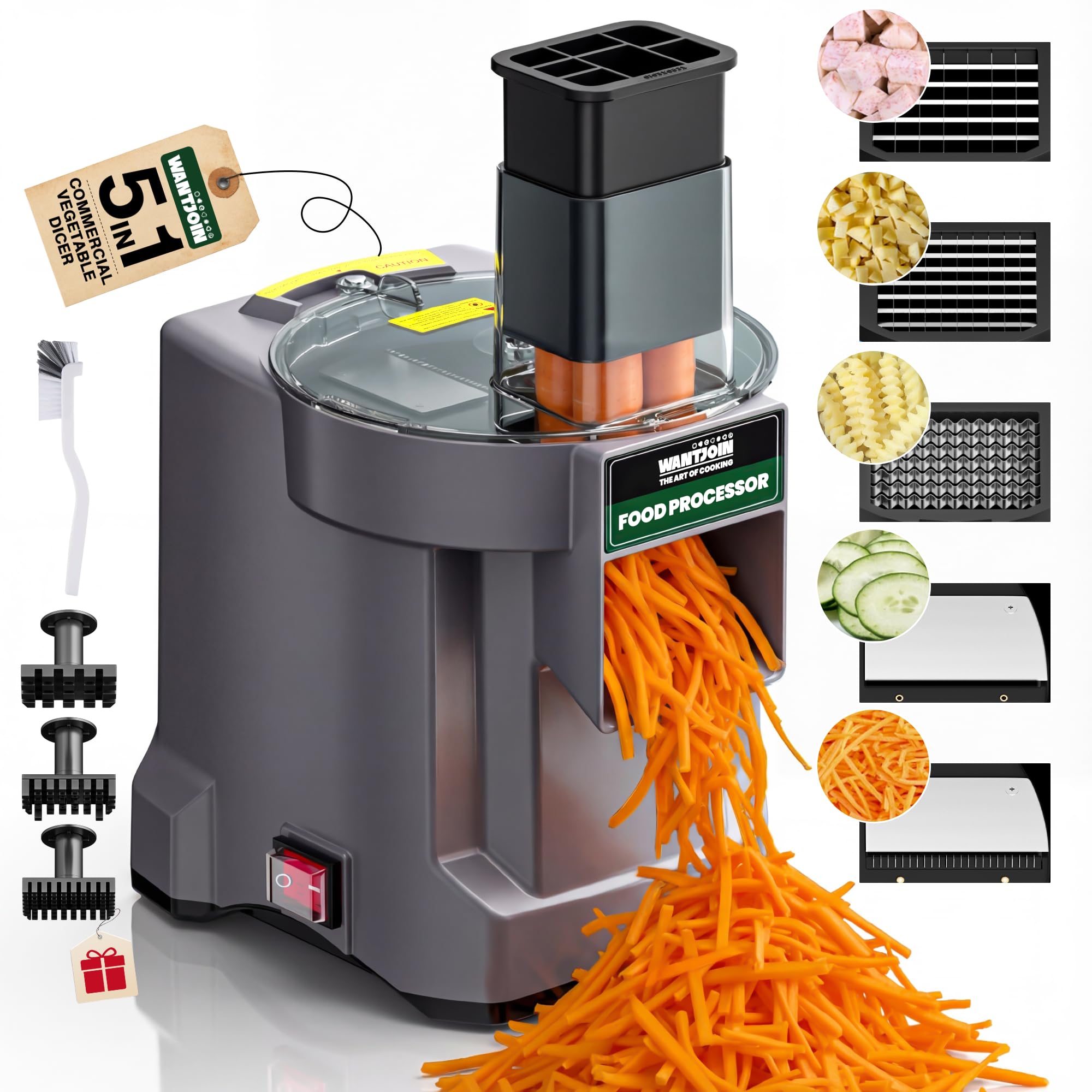
WantJoin WZQPJK86001BKUS01 vegetable chopper
See on AmazonHow the Dice Grids and Chop Setting Turn Whole Vegetables Into Even Pieces
Produce goes down the wide feed chute, the one-touch switch starts the motor, and a pusher drives the food through a stationary cutting grid. The motor supplies the force and the grid sets the shape, which is the opposite of a bowl processor, where a blade spins through the food and minces it irregularly.
Why a grid makes cubes and a blade cannot
A spinning S-blade cuts whatever it touches, so pieces come out in mixed sizes. A grid forces every piece through the same openings, so the output is uniform. That uniformity is the whole point: pieces the same size cook at the same rate, so a tray of roast vegetables or a batch of soup doesn't end up with mush and raw bits in the same pot.
What 100 W and 4000 RPM mean in practice
The motor drives a pusher through a grid rather than spinning a blade through the food, so its wattage doesn't compare directly with a bowl processor's. Dense raw produce still needs to be cut down to fit the chute and to keep the motor from stalling. The anti-skid suction-cup base holds the machine steady while the pusher does its work.
Where the WantJoin WZQPJK86001BKUS01 Vegetable Chopper proves its worth in everyday prep
Hard vegetables in volume are the machine's stated ideal, and the sheet's figures back that up.
Throughput on suitable produce
The sheet rates the chopper for up to 300 lb of produce per hour, and root vegetables, onions and citrus are the foods it names. For batch cooking, preserving or a big roasting tray, that is a lot of prep moved off your hands.
Real dicing, not mincing
The 8 mm and 12 mm grids produce cubes. If you want a diced onion or a uniform mirepoix rather than a pile of uneven fragments, this is the function that earns the machine its place.
No hand force
The motor does the pushing. That is the practical advantage over a manual push-dicer, and it matters most for anyone with grip or wrist limits who still wants cubed vegetables.
Consistent cuts across a batch
Every piece passes through the same grid, so a whole session comes out at one size. You get the same cut in the first pound and the last.
Simple and steady to run
It has one switch, a suction-cup base and few controls to learn. The 100 W motor at 4000 RPM is a modest drive, so expect small-motor noise rather than blender-level sound.
Slicing and shredding included
The fixed 2.5 mm slice and the shredding function broaden the machine beyond dicing, so firm produce can be sliced or shredded in the same session. One-year technical support comes with it.
What the WantJoin WZQPJK86001BKUS01 Vegetable Chopper cannot do well in your kitchen
Soft produce is the first limit, and the manufacturer states it plainly: the chopper is best for hard vegetables and not intended for soft produce like tomatoes. Soft, wet food smears and clogs a grid, so plan on a knife for tomatoes and anything similarly tender.
Hand wash only, with real cleanup time
There is no dishwasher cycle for this machine. The sheet recommends washing the blades immediately after use with the included cleaning tools and avoiding abrasive scrubbers to keep the edges sharp. A dicing grid is a field of edges that has to be cleared cell by cell, so budget real cleanup time after every session, and more if food dries on.
Fixed slice, two dice sizes
The slice is 2.5 mm with no adjustment, and dicing comes in 8 mm or 12 mm only. If you want a paper-thin slice or a finer dice, this machine won't give it.
Dense raw produce needs pre-cutting
Whole, dense roots have to be cut down to fit the wide chute and to avoid stalling a 100 W motor. The 300 lb per hour figure is a throughput rating, not a promise for whole beets straight off the shelf.
Footprint and height
At 13.8 in tall and 8.8 lb, the chopper takes up counter or shelf space and may not fit under upper cabinets. Measure before you plan where it lives.
Single purpose
It dices, slices, chops and shreds. It does not puree or knead, so it doesn't stand in for a full-size food processor.
Care around the grid
The box holds the brush and blade cleaners, not cut-proof gloves, so the exposed grid warrants care during blade changes and washing. Support runs for one year per the sheet.
How the WantJoin Vegetable Chopper Holds Up in Real Kitchens
One buyer on Amazon praises the output on bulk hard vegetables and the evenness of the cuts. Two buyers say the main complaint is cleanup time and the difficulty of clearing the blade and grid, and some buyers find the machine larger than they expected. The large majority of ratings are four or five stars, with a small tail of three-star ratings and no one- or two-star ratings.
Reviews at other retailers mention a motor that stays quiet relative to a blender, and owners on forums report that the machine saves a lot of prep time on big batches while adding several minutes of washing afterward. Treat all of this as owner sentiment rather than measured results.
The WantJoin WZQPJK86001BKUS01 is a capable, single-purpose electric dicer that earns its place in a high-volume hard-vegetable kitchen and disappoints everywhere else. The hard-vegetable focus rules out soft produce like tomatoes, and the hand-wash-only cleanup asks for several minutes at the sink after every session.
If you batch cook, preserve or feed a big household and want uniform dice without hand force, it is a good buy. If you prep soft vegetables, cook in small amounts, or won't wash a grid right after use, spend your money elsewhere.
Frequently asked questions
The questions that decide a purchase of this chopper come down to what it cuts well, what it refuses, and what it asks of you afterward.
Is the slice thickness on the WantJoin WZQPJK86001BKUS01 adjustable?
Slicing on the WantJoin WZQPJK86001BKUS01 stays at about 0.098 in (2.5 mm), with no setting that changes the slice thickness. The only thickness choice comes from swapping the dicing grid between 8 mm and 12 mm, so the smallest cube the machine can make is about 0.31 in (8 mm) and the largest is about 0.47 in (12 mm).
What does the chop setting on the WantJoin WZQPJK86001BKUS01 produce compared with the dice grids?
The chop setup on the WantJoin WZQPJK86001BKUS01 turns produce into small, uneven fragments at 2.5 mm rather than cubes. Uniform cubes come only from fitting the dicing grid, which pushes every piece through identical openings.
Does the WantJoin WZQPJK86001BKUS01 take whole root vegetables down the chute?
The WantJoin WZQPJK86001BKUS01 has a wide feed opening, yet dense roots still need trimming so they drop in and so the 100 W motor does not stall. The 300 lb per hour figure reflects throughput on suitable produce rather than whole unpeeled beets going in straight from storage.
Do buyers of the WantJoin WZQPJK86001BKUS01 find it compact on the counter?
Buyers on Amazon mention that the WantJoin WZQPJK86001BKUS01 claims more counter space than they pictured. The body stands 13.8 in tall and weighs 8.8 lb, so leave room above the machine as well as around the base.