
Best Food Processor to Grind Meat 2026: Motors and Blades That Handle Raw Cuts
When you buy through the Amazon links on this page, we may earn a commission at no extra cost to you. Learn more
Last updated October 30, 2026
The LINKChef FC7048 is the best food processor to grind meat on this page: its 600W motor, about 2.4 qt (2.3L) stainless bowl and two speeds let you work through several batches of cubed chuck without the machine quitting on you, and the built-in overheating protection stops the motor before it cooks itself. The low setting is the one you will use most, because coarse chopping is what ground meat wants.
A processor chops meat rather than extruding it, so the texture lands somewhere between a coarse mince and a fine paste. Cold, cubed meat and short pulses decide the result more than the wattage does.
The best food processors for grinding meat
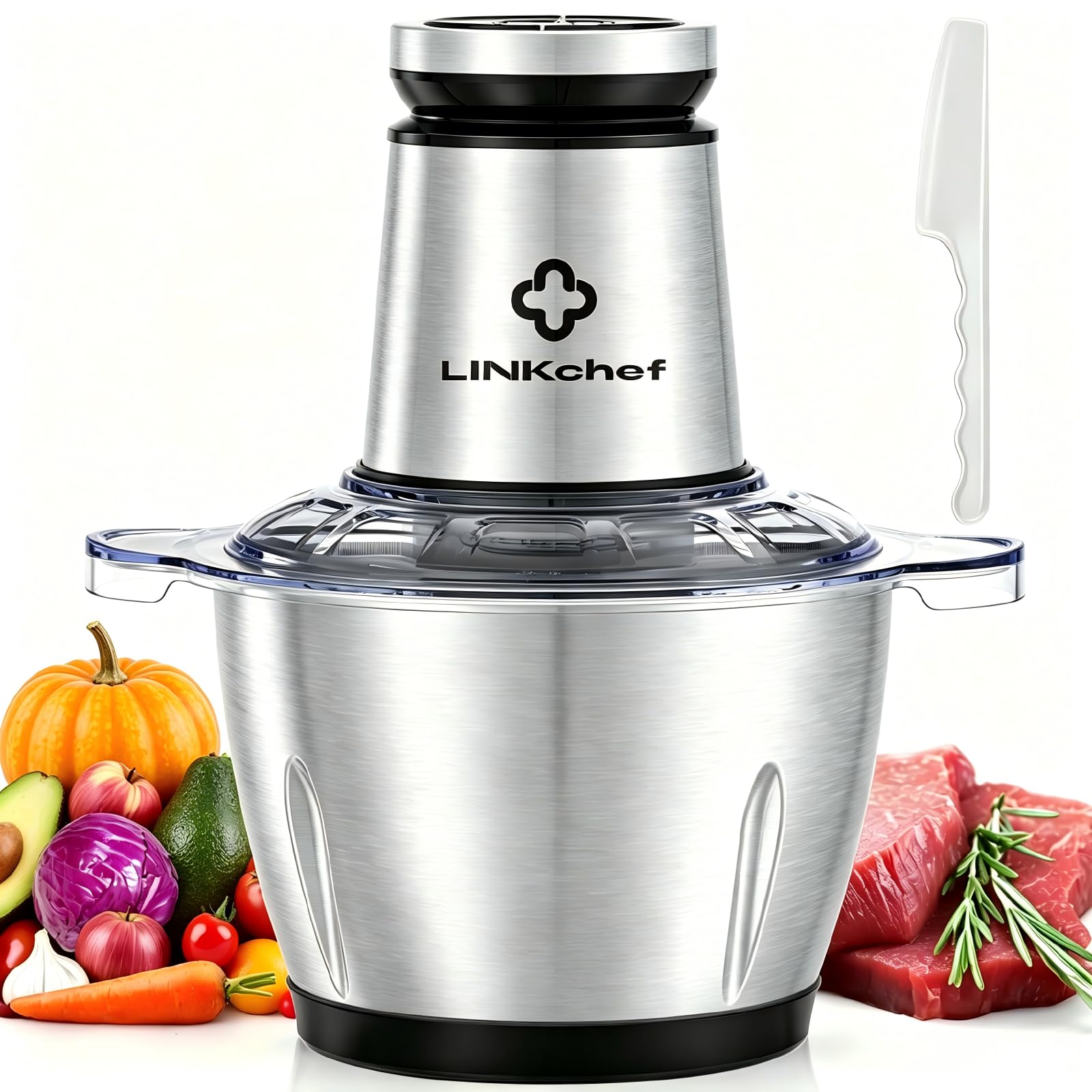
LINKChef FC7048 food processor
See on Amazon
Koios AMJ-301 food processor
See on Amazon
Ganiza GC10 food processor
See on AmazonModel comparison
| Model | Price | Rating | Power | Bowl capacity | Voltage | Best for | |
|---|---|---|---|---|---|---|---|
| | LINKChef FC7048 food processor | $59.99 as of 10/31 See on Amazon | ★ 4.6 (4,700+ ratings) | 600 W | 10 cups | 120 V | Cooks wanting a compact steel-bowl machine for meat and nuts, with a 2.3L stainless bowl and two speeds. |
| | Koios AMJ-301 food processor | $30.99 as of 10/31 See on Amazon | ★ 4.6 (1,600+ ratings) | 500 W | 8 cups each | not stated | Cook who wants the most muscle in glass and written rules gets 500 watts and clear limits. |
| | Ganiza GC10 food processor | $55.99 as of 10/31 See on Amazon | ★ 4.4 (7,700+ ratings) | 450 W | 8 cups each | 120 V | Cook who wants glass for vegetables but not raw chicken residue gets a second stainless bowl. |
 | Spztjk 2LJRJ-3D food processor | $32.99 as of 10/31 See on Amazon | ★ 4.5 (850+ ratings) | 300 W | 8 cups | 120 V | Batch cook who wants a second bowl for meat and a third speed for control gets both bowls. |
 | Qinkada Meat Grinder | $51.99 as of 10/31 See on Amazon | ★ 4.3 (900+ ratings) | 500 W | 14 cups | 120 V | Cooks grinding in volume want the biggest bowl here, and its 14-cup 304 stainless bowl plus four-knife S-blade design answers that. |
Why a food processor is not a meat grinder
A grinder pushes meat through an auger against a perforated plate and extrudes it in strands of a set diameter. A food processor's S-blade sweeps a bowl and cuts meat into irregular pieces, finer with each pass. The result is a chopped grind, not an extruded one.
That texture is right for loose burgers, meatballs, kofta, dumpling and sausage fillings, chili and pâtés. It is the wrong tool for a coarse, snappy sausage grind or a chunky mince with distinct pieces, and it cannot stuff casings. Prolonged processing drives the meat toward an emulsified, hot-dog-like paste, which is a texture some fillings want and most burgers do not.
Buy the processor for the jobs it does well and keep a grinder in mind if coarse sausage is the goal. The machine is not a compromise so much as a different cut.
How the S-blade chops raw meat and what texture you get
The blade passes over the meat repeatedly, and each pulse shortens the pieces. There is no setting for grind size, so the control you have is stopping early.
Work by pulse count and by looking, not by a fixed recipe. A few short pulses give you a coarse grind with visible pieces. A few more take it to medium, where the mixture holds together but still looks crumbly. For fine, keep pulsing and stop to check every couple of bursts, pinching a small amount between your fingers to feel whether it holds.
Once the mixture looks uniform and slightly tacky, it is one pulse away from pasty. Pulsing in short bursts with the machine stopped between them gives even results and keeps the motor from running long. A machine whose pulse control stops the blade promptly is easier to control than one that coasts for a second or two after you let go.
Chilling and cubing meat before you process it
Cubing
Cut meat into even pieces roughly an inch across so the blade meets a consistent load and no large chunk hides under the blade hub. Trim sinew and silver skin, which wrap around the blade, but leave the fat.
Chilling
Firm the meat in the freezer for a short spell, or use well-refrigerated meat and a chilled blade, so the fat stays firm and cuts cleanly instead of smearing against the bowl. Cold meat also lets the machine finish in fewer, shorter runs, which is easier on the motor.
Fully frozen meat is not the goal
It stalls the blade and strains the machine. Partially frozen means firm at the edges and still yielding in the middle.
Batch size and fat ratio for ground meat in a processor bowl
Fill the bowl no more than about a third to a half with cubed meat. For a full-size bowl that means roughly a couple of pounds per batch, and proportionally less for compact bowls. Work in batches rather than topping up.
An overfilled bowl leaves meat above the blade path, so the top stays chunky while the bottom turns to paste, and the motor labors the whole time.
Ground meat needs enough fat to hold together and stay juicy, and around a fifth of the total weight is the usual target for beef, pork and lamb. Fatty meat smears more readily, so it wants a colder starting temperature and shorter pulses. Very lean meat chops cleanly but needs a binder, or a portion processed to a paste, to keep patties from crumbling. A processor cannot separate fat from lean, so the ratio is set by the cut you choose.
Which blade or disc to use for raw meat and which to avoid
The metal S-blade is the tool for grinding meat.
The plastic dough blade is blunt and built for folding flour and water, so it pushes meat around instead of cutting it. Slicing and shredding discs are for firm vegetables and cheese and will not reduce meat to a grind. Any plastic blade assembly is the wrong choice for raw meat on hygiene grounds as well as performance.
On the blade you will actually use, check for a metal hub and center column that seat firmly with no wobble, a seal that comes apart for cleaning, and a blade that sits low in the bowl so meat cannot collect beneath it. A second blade set or a spare bowl is genuinely useful when grinding meat, because it lets one batch rest cold while another processes and keeps raw-meat contact away from other prep.
Keeping raw meat safe in the processor
Keep meat refrigerated until the moment it goes in, process in small batches so nothing sits warm, and refrigerate or cook the ground meat promptly rather than leaving it in the bowl.
Use the processor for raw meat before other prep where possible, or wash it fully in between, and keep a dedicated blade set or bowl for raw meat if the machine offers one.
Disassemble fully when you clean: bowl, lid, blade, hub, seal and feed tube, because meat and fat collect in the center column and under the blade. Rinse with cold water first so fat stays solid and lifts away rather than coating the bowl, then wash in hot soapy water. Put only the parts the manufacturer lists as dishwasher safe in the dishwasher, and hand-wash the blade so its edge stays sharp. A dilute bleach solution on the bowl and work surface after raw meat, then air dry, finishes the job.
Home grinding does not reduce the need to cook ground meat through. Ground beef, pork, lamb and veal should reach 160°F, and ground poultry 165°F.
Our picks by budget
The Koios AMJ-301 is our budget pick because two 8-cup bowls with their own blade sets give you raw-meat separation for the least money, and the rated 30-second run window is enough for a pound or two pulsed in small batches.
The Ganiza GC10 is our mid-range pick because the spring-loaded blades stop the moment the motor is moved away and the 450W copper motor is rated for a longer service life, which is the step up in control and endurance rather than in bowl size.
The LINKChef FC7048 is our premium pick because the 2.3L stainless bowl, the 600W motor and the two speeds with a dedicated low setting for coarse chopping are what let you grind bigger batches of raw meat with less stopping and starting.
Budget
Mid-range
High-end
Which food processor for which buyer
How much meat you grind at a time and whether you also chop vegetables decides which bowl size and motor rating you actually need.
Big batches, most motor
The 2.3L stainless bowl and 600W motor with two speeds let you work through several pounds of cubed chuck, and the overheating protection backs up a long session.
One machine, two bowls
The stainless and glass bowls each have their own blade set, so raw meat and cooked prep never share a surface, and the 500W copper motor handles small pulsed batches within its rated window.
Tightest budget, occasional grinding
The two 8-cup bowls and spring-loaded blades that stop the instant you move the motor away make raw meat handling safer, and the 450W motor is fine for a pound or two at a time with rests between runs.
Compact kitchens and mixed prep
Three speeds, two bowls and a footprint 5.51 inches deep suit a small counter, and the 300W motor is honest about its limits: partially thawed meat, no bones, small batches.
Volume grinding in one bowl
The 14-cup 304 stainless bowl is large, so a big batch of cubed beef fits in one go, with the 2-minute overheat protection covering the run.
Our verdict on the best food processor to grind meat
A food processor grinds meat well when the bowl is loaded lightly, the meat is cold and cubed, and the blade is pulsed. The machine that makes that easiest is the one with the biggest bowl, the most motor endurance and the most controllable speeds, and that is the LINKChef FC7048 for most buyers. The Koios AMJ-301 is the value pick if two bowls and raw-versus-cooked separation matter more to you, and the Ganiza GC10 is the budget route with an honest limit: small batches and rests between runs. Cold meat, an inch dice and a finger on the pulse button decide the result more than the machine does.
Detailed model analysis
Raw meat is the hardest thing a processor bowl sees, because fat smears when it warms and the motor runs longer than it does on onions.
LINKChef FC7048 food processor
The LINKChef FC7048 food processor has a 600 W motor, which matters when you push cold, cubed chuck through it. Low speed handles coarse chopping, which is what ground meat wants.
It comes with one 10-cup (2.3 L) stainless steel bowl and a stainless S blade. High speed is for smooth blending, so save it for sauces.
Overheating protection stops the motor automatically when it gets hot. A safety lock keeps the blades from running unless the unit is assembled, and an anti-slip base keeps it steady during a long batch.
Four blade protectors and a scraper come in the box. They make it safer to pull the blade out of a bowl full of raw meat. The bowl is dishwasher safe, and hand washing works too.
You get only one bowl, so moving from raw meat to vegetables means a full wash in between. It has just two speeds and no pulse function.
It suits home cooks who want a single steel bowl for meat and nuts, and it also handles vegetables, ice, onions, garlic and baby food.
- Brand: Linkchef
- Power: 600 W
- Bowl capacity: 10 cups
- Voltage: 120 V
- Speeds: 2
- Dimensions: 7.28 in deep, 9.06 in wide and 10.24 in high
Koios AMJ-301 food processor
The Koios AMJ-301 food processor gives you 500 W and two bowls, one stainless steel and one glass, at 8 cups each. You can keep raw meat in steel and vegetables in glass.
A pure copper motor drives two sets of stainless S-shaped bi-level blades. It offers two speeds plus a pulse function, and pulsing keeps meat from turning to paste.
Run it no longer than 30 seconds per cycle, then rest it for 20 seconds. If it overheats and shuts off, unplug it and wait 20 minutes. A big batch of cubed beef needs several short runs.
Only one lid comes with the two bowls, so you can't cover both at once. Bowls and blades come apart and are dishwasher safe if the water stays at or below 140°F. It weighs 4.5 lb.
At 500 W it has less power than the LINKChef FC7048 food processor at 600 W. It suits cooks who want two bowls and a pulse button and accept the run and rest limits.
- Brand: Koios
- Power: 500 W
- Bowl capacity: 8 cups each
- Speed settings: 2
- Weight: 4.5 lb
- Dimensions: 8.66 in deep, 7.48 in wide and 10.37 in high
Ganiza GC10 food processor
The Ganiza GC10 pairs a 450 W full-copper motor with two 8-cup bowls, one glass and one SUS 304 stainless steel. The steel bowl is the one you keep for raw meat.
Two sets of S-shaped stainless blades let you dedicate one to meat and one to vegetables, and they are removable for cleaning. Two speeds handle meat, fish, vegetables, nuts and frozen fruit.
The blades are spring-loaded and stop as soon as you lift the motor off. Overheating protection shuts the machine down when it runs hot, and you wait a few minutes before restarting.
Power is its limit. At 450 W it trails the Koios AMJ-301 at 500 W and the LINKChef FC7048 at 600 W, though it tops the SPZTJK 2LJRJ-3D at 300 W.
It weighs 5 lb, has no pulse function, and its 8-cup bowls are smaller than the 10 cups of the LINKChef FC7048. Expect a coarse mince; cold, cubed meat and short bursts work best.
It suits cooks who want a dedicated steel bowl for raw meat and a second set of blades without chasing the top wattage.
- Brand: Ganiza
- Power: 450 W
- Voltage: 120 V
- Bowl capacity: 8 cups each
- Speeds: 2
- Weight: 5 lb
Spztjk 2LJRJ-3D food processor
The SPZTJK 2LJRJ-3D has the lowest motor power of the five, at 300 W. It offsets that with three speeds and two 8-cup bowls, one 304 stainless steel and one glass, each with an anti-slip ring.
The extra speed gives finer texture control, from coarse chop to paste. It is meant to shred a chicken breast in about 10 seconds, and handles meat for people and pets, vegetables, fruit, soft nuts and baby food.
Its limits matter: it is built for fresh and soft ingredients only. Frozen meat must be partially thawed first, and hard bones are off the table.
Overheat protection stops the motor, which must cool down completely before you restart it. Spring-loaded blades halt the moment the motor is disengaged.
The bowls and removable parts are dishwasher safe. The motor base must not be submerged, so wipe it with a damp cloth or small brush.
We find it suits cooks who process small, fresh batches and want three speeds and a second bowl more than raw power.
- Brand: Spztjk
- Power: 300 W
- Voltage: 120 V
- Speeds: 3
- Bowl capacity: 8 cups
- Dimensions: 5.51 in deep, 8.66 in wide and 10.23 in high
Qinkada Meat Grinder
The Qinkada Meat Grinder has the largest single bowl of the five, a 14-cup (3.5 L) 304 stainless steel bowl with a 0.4 mm wall.
Four stainless bi-level blades stack in two layers, so food is cut at more than one height. Three speeds let you step down to a gentler chop for meat.
Power is 500 W, the same as the Koios AMJ-301 and below the 600 W of the LINKChef FC7048. It is meant to finish a task in about 6 seconds.
It grinds onion, nuts, fruit, garlic, small herbs, vegetables and baby food. A safety lock stops the blades when you lift the head, and overheat protection is included. A scraper and cleaning brush come with it.
You get one bowl only, so meat and vegetables share it and need a rinse between. The motor unit cannot be washed, so you wipe it down. It weighs 4.1 lb and needs tall cabinet clearance.
It suits cooks who grind big batches in one go and want three speeds in a single steel bowl.
- Brand: Qinkada
- Power: 500 W
- Voltage: 120 V
- Bowl capacity: 14 cups
- Weight: 4.1 lb
- Dimensions: 7.7 in deep, 6.9 in wide and 12.4 in high
Frequently asked questions
Most ruined batches of home-ground meat come down to warm fat, an overfilled bowl or a blade that ran a few seconds too long.
Can a food processor really grind meat, or do I need a meat grinder?
It chops meat into a usable grind for burgers, meatballs, chili and fillings. It cannot extrude strands through a plate, so a coarse snappy sausage grind and casing stuffing stay out of reach. If those are your goal, a grinder is the right purchase.
What cut of beef should I use for ground meat in a food processor?
Chuck is the default because its natural fat level sits near the target for juicy patties. For a leaner mix, round or sirloin works if you add breadcrumbs, an egg or a little extra fat so the patties hold. Avoid cuts heavy with sinew, which wraps around the blade.
How much meat can I process at once in an 8-cup bowl versus a 14-cup bowl?
An 8-cup bowl takes roughly a pound of cubed meat at a third to a half full. A 14-cup bowl takes about two to two and a half pounds. Topping up past that leaves the upper meat chunky while the lower layer turns to paste.
Why did my ground meat turn out pasty or gummy?
Usually the meat was warm, the bowl was overfilled, or the blade ran too long without a check. Warm fat smears against the bowl instead of cutting, and an overfilled bowl keeps the blade working the bottom layer into a paste while the top stays whole.
Can I grind frozen meat in a food processor?
No. Fully frozen meat stalls the blade and strains the motor. Give it 15 to 30 minutes in the freezer, no more, then cut it into one-inch cubes before it goes in the bowl.
Do I need a special blade to grind meat, or does the standard S-blade work?
The standard metal S-blade is the tool. Use the metal S-blade only; the dough blade and the discs are built for flour and vegetables, and raw meat needs the sharp sweeping edge. Check that the blade hub seats firmly with no wobble and that the seal comes apart for cleaning.
Can I make sausage in a food processor?
You can make the filling, and the processor takes it all the way to an emulsified texture if you keep pulsing. You cannot stuff casings with it, and a coarse country-style sausage with distinct pieces of fat and lean is beyond what a spinning blade produces.
How do I clean a food processor after raw meat?
Take it fully apart, including the blade hub, seal and feed tube. Rinse with cold water first so the fat stays solid and lifts off, then wash in hot soapy water. Hand-wash the blade to keep its edge, and put only the parts the manual lists as dishwasher safe in the machine.