
Best Food Processor for Pie Crust 2026: Pulsing Butter Into Flour Without Overworking It
When you buy through the Amazon links on this page, we may earn a commission at no extra cost to you. Learn more
Last updated October 31, 2026
The Cuisinart Custom 14 DFP-14BCNY is the best food processor for pie crust because its 14-cup bowl holds a double crust with room to spare, its stainless chopping blade sits low enough to keep cutting cold butter instead of spinning over the flour, and its two-button control gives you a short, deliberate pulse. If you bake one pie at a time, a 7-cup machine is the sensible ceiling.
Size the bowl by flour, not by pie count: a single 9-inch crust takes about 1¼ to 1½ cups of flour, a double crust 2½ to 3 cups. Use the metal S-blade, not the dough blade, and stop pulsing at pea-sized butter pieces.
The best food processors for pie crust in 2026

Cuisinart Custom 14 DFP-14BCNY food processor
See on Amazon
Cuisinart DLC-10SYP1 food processor
See on Amazon
Cuisinart Pro Custom 11 DLC-8SBCYP1
See on AmazonModel comparison
| Model | Price | Rating | Weight | Power | Voltage | Best for | |
|---|---|---|---|---|---|---|---|
| | Cuisinart Custom 14 DFP-14BCNY food processor | $249.99 as of 10/31 See on Amazon | ★ 4.5 (15,300+ ratings) | 18 lb | 720 W | 120 V | Family cooks who work from scratch get a 14-cup bowl, two-button control and a 5-year motor warranty in a planted 18-pound base. |
| | Cuisinart DLC-10SYP1 food processor | $169.95 as of 10/31 See on Amazon | ★ 4.5 (3,900+ ratings) | 4.7 kg | 600 W | not stated | Bakers who knead dough in the machine get the strongest motor here at 600 watts in white. |
| | Cuisinart Pro Custom 11 DLC-8SBCYP1 | $195.75 as of 10/31 See on Amazon | ★ 4.5 (3,400+ ratings) | 16.9 lb | 625 W | 120 V | Bakers and batch cooks wanting full-size capacity and a long warranty get 11 cups, 625 watts and a 3-year warranty without the largest bowl. |
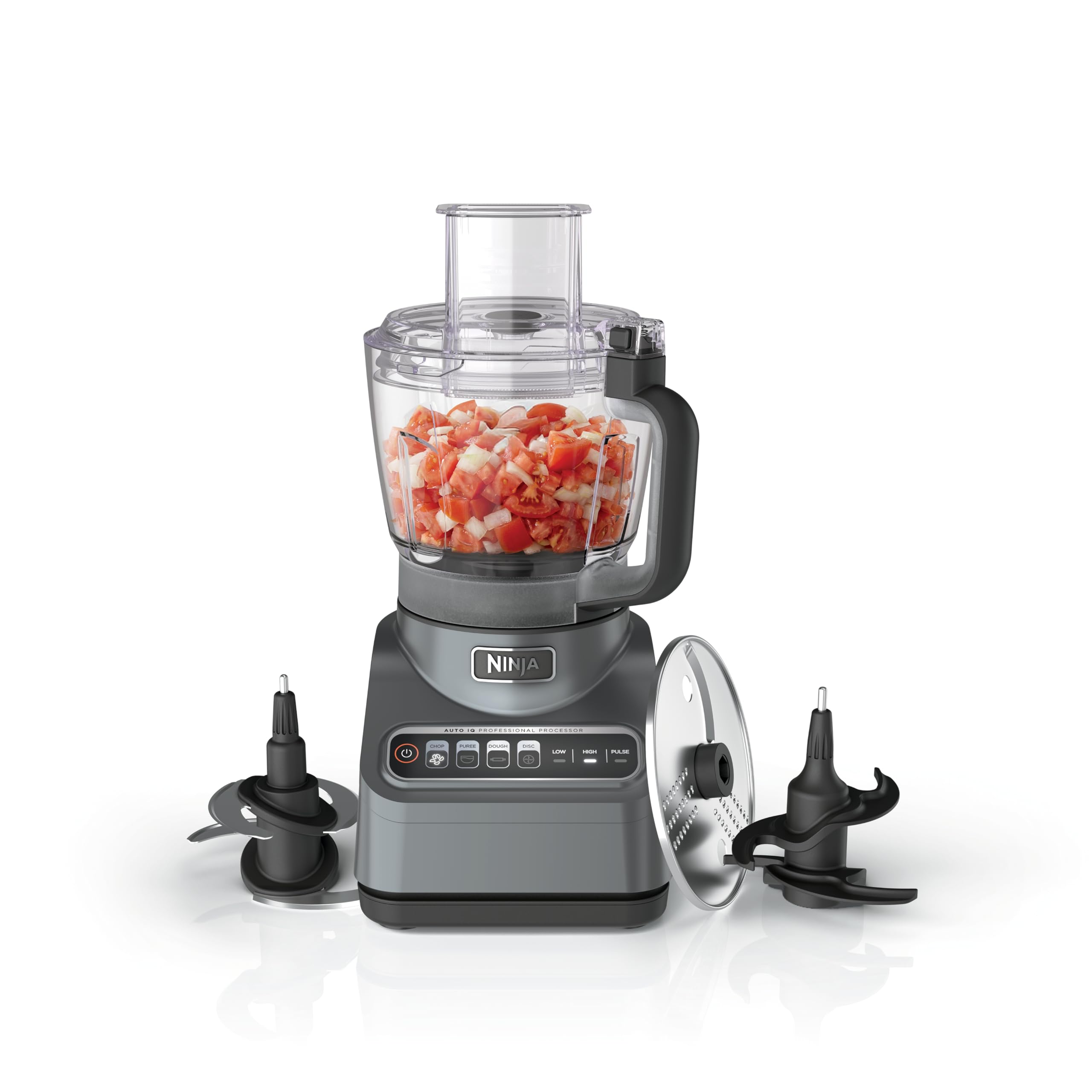 | Ninja Professional Plus BN601 | $99.99 as of 10/31 See on Amazon | ★ 4.6 (14,400+ ratings) | 7.7 lb | not stated | 120 V | Two-to-four-person households wanting one-button chopping get four Auto-IQ programs and a full disc set in a 9-cup bowl. |
 | Cuisinart FP-7 food processor | $79.00 as of 10/31 See on Amazon | ★ 4.2 (350+ ratings) | 7.2 lb | 350 W | 120 V | Bakers making double crusts in a compact kitchen get a 7-cup bowl and universal blade that handles dough in one piece. |
Why the S-blade beats the dough blade for pie crust
The metal S-blade is the pie-crust blade. It has long, sharp arms that sweep close to the bowl wall and the bowl bottom, so it picks up flour from the edges and pulls it back into the work zone where the butter is.
The dough blade is short, blunt and set in from the bowl wall. On a small batch it cannot reach the flour at the edge, so the flour stays dry while the blade turns in the middle. It is designed for high-hydration yeast dough that fills the bowl and needs kneading rather than cutting.
Why speed matters here
The metal blade cuts cold butter faster and more evenly, and every extra second in the bowl warms the fat. A sharp blade that finishes the job in a few pulses keeps the butter cold, which is the whole point.
When a dough blade is worth using
A dough blade becomes useful when the batch is large enough to fill the bowl, roughly 3½ cups of flour and up. That is above a standard double crust, so most pie bakers never need one. A machine sold with a dough blade is not thereby better for pastry.
What actually determines how cleanly a machine cuts fat in is the blade's position: low and close to the bowl bottom, where the flour and butter sit.
What pulsing does to butter that running does not
Continuous running smears soft butter into the flour as a coating. That gives you tenderness, but it kills flakiness, because there are no intact pieces of fat left to create layers.
Short pulses keep the butter in visible flat pieces. Those pieces hold water, since butter is about 20% water, and in the oven that water turns to steam and lifts the dough into layers. The pieces are the flakiness.
Pulse length and count
Use one-to-two-second bursts and stop to look between them. The count varies by machine: a powerful machine with a fast blade may need five pulses where a slower one needs ten to fifteen. There is no universal number, only the look of the crumb.
The long-pulse problem
Some machines keep running a beat or two after you release the button. That overrun is exactly what turns coarse meal into paste, because you cannot stop at the moment the butter reaches the right size. A responsive pulse button is a pie-crust feature, and it is worth checking before you buy: press it in the store or read the control description carefully.
Reading the crumb before you add water
Stop by eye and by touch, not by timer. The machine cannot tell you when the fat is right, so you have to look.
Coarse meal
Flour and fat are combined into uneven crumbs with dry flour still visible. Keep going. This stage looks done to a nervous baker, but the butter is still too fine.
Pea-sized pieces
This is the target: visible flat butter bits the size of peas to lentils, coated in flour, with the mixture still loose. Stop here.
Overworked paste
Uniform, sandy, no visible fat, starting to clump. You have gone too far. The crust will be tender but not flaky, and there is no way back except starting over.
The water stage
Drizzle ice water through the feed tube a tablespoon at a time, pulsing once between additions. Stop when a squeezed handful holds together and does not crumble. The machine cannot feel the dough, so squeeze a handful to check it. It is better to under-water and finish by hand than to add one tablespoon too many.
Keeping the dough cold from freezer to feed tube
Cold is the whole game, and the machine is a heat source. Blade friction and motor heat warm the fat from below while your kitchen warms it from above.
Chill everything you can
Cube the butter and freeze it 15 to 30 minutes, or chill it hard in the fridge. Use ice water. If the kitchen is warm, above roughly 73°F ambient, chill the bowl and blade in the freezer for a few minutes, because everything warms on contact at that temperature.
The two-stage cut
Pulse the fat into part of the flour first to build a fat-coated base, then add the remaining flour and pulse briefly. This keeps a reserve of uncoated flour and protects the layering.
Very cold, not solid
Fully frozen solid butter is counterproductive: it shatters and cracks rather than flattening into sheets. Very cold but still plastic is the target. Aim for dough around 65 to 70°F when it comes out of the machine.
Finishing the dough by hand and cleaning butter out of the work bowl
The machine's job ends at the crumb and the first of the water. Turn the dough out onto the counter and bring the last of the water in by hand, pressing and folding rather than kneading. This is where you control gluten and see the butter streaks. Form discs, wrap, and chill 30 minutes to overnight.
The cleanup is the real cost
Cold butter residue hides in the blade hub, under the blade, in the feed tube and around the bowl's seal. Rinse with hot water and a little dish soap immediately, before the butter sets.
- Use a soft brush or a plastic scraper in the feed tube and around the hub.
- Never use a scouring pad on the plastic.
- Run the blade and discs through the dishwasher only if the maker says they are dishwasher safe.
A machine that comes apart easily, with a removable hub, a detachable disc stem and a wide feed tube, is easier to live with than one that does not.
Our picks by budget
The Cuisinart FP-7 is our budget pick because 7 cups is the right bowl for a double crust and the universal blade handles dough in one piece, so there is less to clean after the butter goes in.
The Cuisinart DLC-10SYP1 is our mid-range pick because the heavier-duty 600 W motor is built for consecutive crusts, and both a chopping blade and a dough blade come in the box.
The Cuisinart Custom 14 DFP-14BCNY is our premium pick because the 14-cup bowl and 18 lb stainless base let you work two double crusts back to back without the machine moving or the blade losing the flour.
Budget
Mid-range
High-end
Which food processor for which pie baker
The right machine for you depends on how much flour you work at once and how many crusts you make in a session.
One pie at a time, simplest machine
The 7-cup bowl is the right size for a double crust, and the universal blade means fewer parts to clean butter out of.
Bakes regularly, wants the motor to last
The 600 W motor is built for batch-after-batch dough, and the 7-cup bowl keeps the blade sweeping flour back into the work zone.
Holiday baker, several double crusts
The 14-cup bowl takes a double crust plus a second batch without washing up, and the 18 lb base stays put under stiff dough.
Wants pastry and everyday slicing in one
Eleven cups give a double crust headroom plus three slicing and shredding discs, in a footprint close to the 7-cup models.
Already owns a preset-driven machine
Nine cups covers a double crust, but check the pulse response before trusting the presets with pastry.
Our verdict on the best food processor for pie crust
The Cuisinart Custom 14 DFP-14BCNY wins because its capacity matches a double crust with room to spare, its metal blade sits low, its pulse is yours to control, and its 18 lb base does not walk across the counter. The Cuisinart DLC-10SYP1 is the value pick for regular bakers, and the Cuisinart FP-7 is the compact pick for one pie at a time.
Size the bowl by flour, use the S-blade, and stop at pea-sized pieces.
Detailed model analysis
Pie crust rewards a machine that cuts cold fat fast and then gets out of the way, so bowl size, blade position and pulse response decide the result.
Cuisinart Custom 14 DFP-14BCNY food processor
The Cuisinart Custom 14 DFP-14BCNY has a 14-cup bowl, so a double crust fits without crowding the flour and butter. It also kneads dough and slices and shreds fruit for the filling.
Control is simple. Two buttons, On and Off/Pulse, let you tap short bursts and stop when the butter looks pea-sized. It runs at one speed, plus pulse.
A stainless steel chopping/mixing blade does the cutting, driven by a 720-watt motor. The body is brushed stainless steel. The motor carries a full 5-year warranty, and the whole unit has a limited 3-year warranty.
The extra-large feed tube works with small and large pushers, and a detachable disc stem eases cleanup. The parts are dishwasher safe. A 4 mm slicing disc and a medium shredding disc come in the box.
Know the limits: a single pie leaves much of the bowl empty, and the slicing and shredding discs are not adjustable.
It suits bakers who make double crusts, and anyone who wants a long motor warranty and dishwasher-safe parts.
- Brand: Cuisinart
- Capacity: 14 cups
- Power: 720 W
- Voltage: 120 V
- Dimensions: 11 in deep, 7.9 in wide and 14.8 in high
- Weight: 18 lb
Cuisinart DLC-10SYP1 food processor
The Cuisinart DLC-10SYP1 has a 7-cup bowl, sized for baking one pie at a time. A 600-watt motor turns the stainless steel chopping/mixing/dough blade, and it also kneads dough.
It runs at one speed, with on and off/pulse buttons. Pulsing is your only way to control how fine butter gets, so stop at pea-sized pieces.
An extra-large feed tube takes whole fruits and vegetables, with a small insert for smaller pieces. The box adds a 4 mm slicing disc, a stainless steel shredding disc, a spatula and two pushers.
The body is BPA-free plastic and weighs about 10.4 lb (4.7 kg). A detachable disc stem, a compact flat cover and a recipe book come in the box. The motor has a full 5-year warranty, and the unit a limited 3-year warranty.
The limits are care and capacity. It is hand wash only, and bakers who make double crusts or big batches will outgrow 7 cups.
It suits bakers who make one pie at a time and don't mind washing the parts by hand.
- Brand: Cuisinart
- Power: 600 W
- Bowl capacity: 7 cups
- Dimensions: 7 in deep, 11.25 in wide and 14.5 in high
- Weight: 4.7 kg
- Speeds: 1
Cuisinart Pro Custom 11 DLC-8SBCYP1
The Cuisinart Pro Custom 11 DLC-8SBCYP1 has an 11-cup bowl, a middle size that gives a double crust more room than a 7-cup bowl.
A steel chopping/mixing blade handles the butter, driven by a 625-watt motor. With manual control, you decide when to stop and watch the butter size yourself.
Three discs come with it: two for slicing and one for shredding. Two pusher sizes work with the cover's large feed tube, and a spatula is included.
It also processes dough, chops, mixes and purees sauces, so the same machine handles the fruit for the filling. The parts are dishwasher safe, which saves the sink after a buttery batch.
It weighs 16.9 lb and runs on 120 V through a cord. The limits: one speed and manual control only.
We think it suits bakers who want a full-size bowl and dishwasher-safe parts.
- Brand: Cuisinart
- Capacity: 11 cups
- Power: 625 W
- Voltage: 120 V
- Dimensions: 7 in deep, 11.25 in wide and 14.5 in high
- Weight: 16.9 lb
Ninja Professional Plus BN601
The Ninja Professional Plus BN601 offers four Auto-iQ preset programs for chopping, slicing, pureeing and dough making, each started with one touch. The presets also cover hummus, sauces and sliced fruit.
It includes a chopping blade, a dough blade and a reversible slicing and shredding disc. The 9-cup bowl sits between the 7-cup Cuisinart FP-7 food processor and the 11-cup Cuisinart Pro Custom 11 DLC-8SBCYP1.
The motor is rated at 1000 peak watts, a maximum figure rather than steady power, with 3 speeds. It weighs 7.7 lb, and only the Cuisinart FP-7 food processor is lighter.
Removable parts are BPA-free and dishwasher safe. A safety lock keeps it from running unless it is put together correctly.
One limit: a single reversible disc handles both slicing and shredding, where the Cuisinart Pro Custom 11 DLC-8SBCYP1 comes with three discs. For crust, use the chopping blade, not the dough blade.
If you often make double crusts in one batch, the 14-cup Cuisinart Custom 14 DFP-14BCNY food processor gives you more room. This model suits cooks who want one-touch presets and a mid-size bowl.
- Brand: Ninja
- Peak power: 1000 W
- Bowl capacity: 9 cups
- Voltage: 120 V
- Weight: 7.7 lb
- Dimensions: 7.76 in deep, 9.88 in wide and 16.02 in high
Cuisinart FP-7 food processor
The Cuisinart FP-7 is the lightest of the five at 7.2 lb. Its 7-cup bowl matches the size we suggest for one pie at a time.
Two buttons run it, On and Pulse/Off, driving a 350-watt motor. A universal blade covers chopping, mixing and dough, so one blade handles crust.
A reversible disc slices and shreds, with a fine side and a medium side. A removable hub lets the attachments nest together for compact storage.
The Cuisinart DLC-10SYP1 has the same 7-cup bowl and hand wash care, but it comes with a spatula, small and large pushers and a full 5-year motor warranty.
The limits: it is hand wash only, one disc covers both slicing and shredding, and 7 cups is small for double crusts or big dough batches. The Cuisinart Custom 14 DFP-14BCNY gives you far more room.
It suits bakers who make one crust at a time and want a light machine with simple controls.
- Brand: Cuisinart
- Bowl capacity: 7 cups
- Power: 350 W
- Voltage: 120 V
- Weight: 7.2 lb
- Dimensions: 7.5 in deep, 9 in wide and 14 in high
Frequently asked questions
Most pie-crust problems trace back to bowl size, blade choice or one pulse too many.
What size food processor do I need for pie crust?
Seven cups is the practical answer for a double crust, since it holds 2½ to 3 cups of flour with room to pulse. A 4-cup machine does a single crust, and 11 to 14 cups is for bakers who make several pies in one session.
Can you make pie crust in a food processor?
Yes. It is the fastest way to cut cold butter into flour, as long as you pulse in short bursts and stop while the butter is still in visible pieces.
S-blade or dough blade for pie crust?
The metal S-blade. Its long arms reach the flour at the bowl's edge, while the dough blade is built for large batches of yeast dough that fill the bowl.
Do I need a dough blade?
No. A standard double crust tops out at 3 cups, so a dough blade only earns its place once a batch passes that mark.
How many pulses should I give the dough?
Until it looks right, not for a set count. A fast, powerful machine may need five pulses and a slower one ten to fifteen, in one-to-two-second bursts.
Why is my pie crust crumbly?
Not enough water, or fat that was too cold and brittle to coat the flour. Squeeze a handful before you stop adding water.