
Best Glass Food Processor 2026: Bowls That Won't Stain or Hold Odors
When you buy through the Amazon links on this page, we may earn a commission at no extra cost to you. Learn more
Last updated October 30, 2026
Yes, glass-bowl food processors exist, and the Ganiza GC10 is the one to start with: an 8-cup glass bowl for produce and an 8-cup stainless bowl for meat, each with its own blade set, so the glass bowl is the main bowl and not a spare. The catch you need before you order: in the US, glass work bowls come only on compact, top-motor choppers of 8 cups or less. No major brand sells a full-size processor with a glass bowl.
What you get for that trade is a bowl that will not stain from tomato or turmeric, will not keep last night's garlic, and lets you watch the dice and the color as you pulse.
The best glass food processors of 2026

Ganiza GC10 food processor
See on Amazon
Koios AMJ-301 food processor
See on Amazon
La Reveuse LARB4016 food chopper
See on AmazonModel comparison
| Model | Price | Rating | Power | Voltage | Bowl capacity | Best for | |
|---|---|---|---|---|---|---|---|
| | Ganiza GC10 food processor | $55.99 as of 10/31 See on Amazon | ★ 4.4 (7,700+ ratings) | 450 W | 120 V | 8 cups each | Cook who wants glass for vegetables but not raw chicken residue gets a second stainless bowl. |
| | Koios AMJ-301 food processor | $30.99 as of 10/31 See on Amazon | ★ 4.6 (1,600+ ratings) | 500 W | not stated | 8 cups each | Cook who wants the most muscle in glass and written rules gets 500 watts and clear limits. |
| | La Reveuse LARB4016 food chopper | $37.99 as of 10/31 See on Amazon | ★ 4.5 (1,700+ ratings) | 300 W | 120 V | 7 cups | Cook whose processor mostly makes sauces, dressings and dips gets a 7-cup glass bowl and whisking disc. |
 | Spztjk 2LJRJ-3D food processor | $32.99 as of 10/31 See on Amazon | ★ 4.5 (850+ ratings) | 300 W | 120 V | 8 cups | Batch cook who wants a second bowl for meat and a third speed for control gets both bowls. |
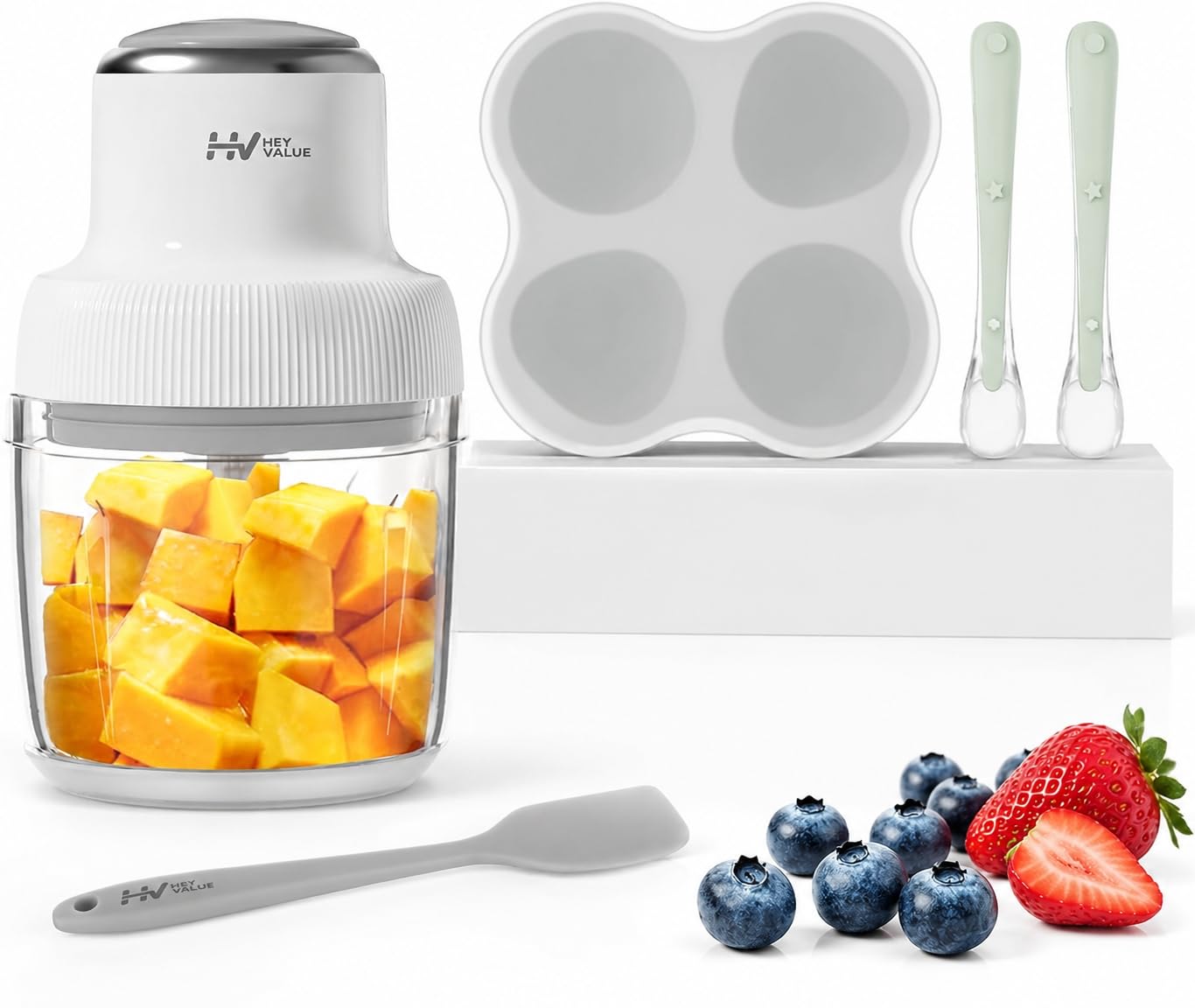 | Heyvalue HB-FS01 baby food maker | $39.99 as of 10/31 See on Amazon | ★ 4.5 (3,300+ ratings) | 200 W | 120 V | not stated | Parent or meal-prepper making purees and small batches gets a 20 oz glass jar as the whole container. |
Why a glass bowl changes what you can see and smell
A clear bowl turns chopping into something you can watch. You see the dice size, the color change when onion starts releasing water, the moment a puree goes from grainy to smooth, and the second a paste starts to look oily or over-worked. That visual feedback is what lets you stop before you cross the line between salsa and soup, or between pesto and a bitter paste.
Where watching pays off most
It matters most with ingredients that go from right to ruined in a few seconds. Garlic and ginger turn from mince to paste fast. Herbs in oil go from bright to dark. Nuts for butter go from crumbly to oily. Bright red tomato and deep orange turmeric let you see the color bloom and know the blade has reached every corner of the bowl.
What you lose with an opaque bowl
With a solid bowl you judge by sound and by lifting the lid. Every lift lets air in, loses the rhythm of pulsing, and adds a step between you and the texture you are chasing. A clear bowl keeps the lid on and your eyes on the food.
The bowl is only half the story
Say it plainly: the lid, the gasket and the blade hub are still plastic and still touch food. A glass bowl is not a plastic-free appliance. It is a bowl that will not stain or hold odors, which is a different and smaller promise than a machine with no plastic anywhere.
How glass resists staining and odors where plastic absorbs them
Glass is non-porous and non-reactive. It has no surface pores for pigment or aroma molecules to lodge in, so turmeric, tomato, curry, beet and berry do not tint it, and garlic, onion, fish and spice smells rinse away instead of settling in. Plastic, even good plastic, is softer and picks up micro-scratches with use and washing. Those scratches are exactly where color and smell live, which is why a plastic bowl goes dull and keeps a whiff of last night's garlic no matter how you wash it.
Where a lingering smell really comes from
In a glass-bowl machine, a smell that will not leave comes from the parts that are not glass: the lid, the silicone gasket, the blade hub and the center pylon the blade drops onto. Wash those in hot soapy water, and every so often pull the gasket out and clean underneath it, because that groove traps more than the bowl ever will.
The small daily payoff
Glass also shows at a glance whether it is actually clean. No haze, no faint orange ring, no guessing. You rinse it, you look, and you know.
The weight and breakage trade-off of a glass bowl
Glass is heavy, and an 8-cup glass bowl full of salsa or breadcrumb is a two-handed lift. The machine itself is heavier than a plastic-bowl chopper of the same size, and that mass is what keeps it steady on the counter while the blade runs. Treat the weight as part of the design, not a flaw.
Handling and pouring
Lift by the bowl, never by the lid or the power pod. Pour with a spatula rather than tipping to the last drop, because the last drop is where a wet hand and a heavy bowl meet. Set the bowl down on a towel or a board, never on a hard edge or the lip of the sink.
Thermal shock is the real risk
Breakage is almost always thermal shock or a knock, not the motor. Thermal shock is a cold bowl meeting hot food, or a hot bowl meeting cold water. Let both come to room temperature, and never pour near-boiling liquid into a glass bowl. A chipped rim is a stress point: retire a chipped bowl rather than using it.
Washing and storage
Wash by hand where the maker says hand wash. Keep blades in their protectors rather than loose in the bowl, where they chip the glass every time you set it down. Store bowls without stacking weight on the rim.
What a glass bowl cannot do that a plastic or metal one can
Glass bowls come on top-motor choppers, and that architecture sets the limits. The motor sits in the lid, the bowl sits on the base, and the blade drops onto a center hub. There is no feed tube, so there is no slicing, shredding or julienning, and no discs to swap in. There is usually no dough blade or kneading program, because kneading needs a long continuous run and these machines are built for bursts of 30 seconds or less.
Capacity stops at 8 cups
Every glass bowl in this category tops out at 8 cups, and the working fill is lower than the nominal figure. Fill to the line, not the rim, or you will wear out the motor and paint the counter.
Why the biggest machines never get glass
A full 12- or 14-cup glass bowl would be too heavy to lift safely when full and too heavy for the machine to hold steady under a blade stack. That is why glass is rarely offered on the largest-capacity machines, and why no full-size processor from a major brand has one.
Who should buy a different machine?
If you slice cucumbers by the pound, shred blocks of cheese or knead dough, you are shopping for a full-size processor with a plastic or metal bowl. A glass chopper is the second tool in that kitchen.
Reading a glass food processor listing without being misled
The first check is whether the glass bowl is the main work bowl or a secondary accessory bowl bundled with a plastic or steel one. Both arrangements are sold, and the difference decides how much of your chopping actually happens in glass. Read the box contents line by line and confirm the glass bowl is named there, because bowl combinations change between configurations of the same model.
Check that the rest of the machine matches the bowl
A glass bowl is heavy, so the base, lid and blade hub have to be built for it. Look for a lid that seats with a firm turn, a blade that drops onto a proper center pylon, and anti-slip feet or a mat under the base. A bowl that walks across the counter is a bowl that ends up on the floor.
Look for the numbers that decide how you use it
Find the glass type where it is stated, since borosilicate tolerates temperature change better than tempered soda-lime glass. Look for a published heat limit, a duty cycle in seconds on and seconds off, and a dishwasher statement that separates bowl, lid and blades. Treat Tritan as what it is: a clear, BPA-free plastic, not glass. And note that warranty terms are often not published on these machines, so buy where you can return.
Our picks by budget
The Koios AMJ-301 is our budget pick because it puts the most power on this page, 500 watts, into a two-bowl glass-and-steel set, and it publishes the operating rules that keep a small motor alive: 30 seconds on, 20 seconds off.
The Ganiza GC10 is our mid-range pick because the money goes into the bowl set that solves the problem: an 8-cup glass bowl and an 8-cup stainless bowl, each with its own blades, plus spring-loaded blades that stop when the motor is lifted.
The HEYVALUE HB-FS01 is our premium pick because it is a different kind of machine: a high-borosilicate glass jar with a six-blade assembly, one-button operation and a full kit for portioning, freezing and storing purees.
Budget
Mid-range
High-end
Which glass food processor fits your kitchen
Most buyers know their kitchen habit before they know the specs, and the habit is what should pick the machine.
The all-round chopper
You want glass for most jobs but raw meat in something else. The 8-cup glass bowl and 8-cup stainless bowl each have their own blades, so produce and poultry never share a bowl.
The maximum-power cook
You want the strongest motor in glass and a machine that states its rhythm. 500 watts, 30 seconds on, 20 seconds off, and a 20-minute wait if it overheats.
The sauce and dressing maker
Your processor mostly makes vinaigrettes, pesto and whipped cream. The 7-cup glass bowl, whisking disc and spatula cover that, with a one-year warranty behind it.
The batch cook
You prep in volume and want a second bowl for meat plus a third speed for control. Both 8-cup bowls have anti-slip rings to keep them planted.
The parent making purees
You want the glass to be the whole container, not just the bowl. A 20 oz high-borosilicate jar, a six-blade assembly, one button, and a freezer tray and spoons for portioning.
Our verdict on the best glass food processors
The Ganiza GC10 is the overall pick because it solves the problem the way the problem actually shows up: an 8-cup glass bowl for everything that stains, an 8-cup stainless bowl for everything that should not go in glass, a 450-watt copper motor, spring-loaded blades that stop when the motor is lifted, and overheat protection that resets after a few minutes. For power, the Koios AMJ-301 gives you 500 watts and a written rhythm. For sauces, the La Reveuse LARB4016 pairs a 7-cup glass bowl with a whisking disc. For purees, the HEYVALUE HB-FS01 puts high-borosilicate glass around the whole batch.
Buy a glass-bowl chopper for chopping, mincing and pureeing without stains or smells, and keep a full-size machine for slicing, shredding and dough.
Detailed model analysis
A glass bowl only earns its place if the machine around it is built for the weight and the job, so each pick is judged first on its glass, its bowl set and the limits it publishes.
Ganiza GC10 food processor
The Ganiza GC10 puts an 8-cup glass bowl at the center of the kit. Tomato, turmeric and garlic stay in a bowl that does not stain or hold odors.
A second 8-cup bowl in SUS 304 stainless steel takes raw meat and fish, so chicken residue never touches the glass you use for vegetables. Each bowl has its own removable S-shaped stainless steel blades.
The full-copper motor runs at 450 W with 2 speeds. That beats the La Reveuse LARB4016 and the SPZTJK 2LJRJ-3D, both at 300 W, though the Koios AMJ-301 goes higher.
Spring-loaded blades stop the moment you lift the motor off, and an overheating cutoff stops the machine when it runs hot.
Now the limits. After a cutoff, you wait a few minutes to restart. It has only 2 speeds, where the SPZTJK 2LJRJ-3D has 3, and at 5 lb it is heavier than the Koios AMJ-301 at 4.5 lb.
It suits the cook who wants glass as the everyday bowl, plus a separate stainless bowl for meat and fish.
- Brand: Ganiza
- Power: 450 W
- Voltage: 120 V
- Bowl capacity: 8 cups each
- Speeds: 2
- Weight: 5 lb
Koios AMJ-301 food processor
The Koios AMJ-301 runs on a 500 W pure copper motor with two sets of S-shaped bi-level blades. It offers 2 speeds and a pulse function for short, controlled bursts.
You get a glass bowl and a stainless steel bowl, 8 cups each. Tomato, turmeric and garlic won't stain or linger in the glass, and the stainless bowl keeps meat separate. Both stack to save storage space.
Bowls and blades are removable and dishwasher safe with water at or below 140°F. Rubber base rings hold the bowls in place and dampen noise. It weighs 4.5 lb, lighter than the Ganiza GC10 at 5 lb.
The limits are usage rules. Each run must not exceed 30 seconds, with a 20 second rest between cycles. After an overheat shutdown, unplug it and wait 20 minutes.
Only one lid comes for the two bowls, and you should hold the bowl tight while it runs. It works on 120 V only.
It suits the cook who wants a glass-plus-stainless set and accepts short cycles and strict rest times.
- Brand: Koios
- Power: 500 W
- Bowl capacity: 8 cups each
- Speed settings: 2
- Weight: 4.5 lb
- Dimensions: 8.66 in deep, 7.48 in wide and 10.37 in high
La Reveuse LARB4016 food chopper
The La Reveuse LARB4016 is a compact chopper with a 7-cup BPA-free glass bowl. Glass keeps tomato and garlic from staining or lingering.
A bi-level stainless steel blade with 4 leaves chops, and two one-touch pulse buttons give you 2 speeds. You control texture by tapping. It handles onions, fruit, meat and nuts.
A whisking disc whisks eggs, and a spatula frees stuck pieces or mixes the chopped food. An anti-slip rubber mat keeps it steady. The 1 year warranty covers manufacturer's defects.
At 300 W it has less power than the Ganiza GC10 at 450 W and the Koios AMJ-301 at 500 W. It has 2 speeds, where the SPZTJK 2LJRJ-3D offers 3.
The bowl is a single-serving size and hand wash only. If overload protection stops the machine, rest the motor for about 30 to 60 minutes.
It suits cooks making small batches of baby food, sauces and dressings who want a glass bowl, a whisking disc and a warranty.
- Brand: La Reveuse
- Bowl capacity: 7 cups
- Power: 300 W
- Voltage: 120 V
- Speeds: 2
- Bowl material: Glass
Spztjk 2LJRJ-3D food processor
The SPZTJK 2LJRJ-3D has two bowls of 8 cups each. One is glass, described as BPA-free, for fruit and vegetables. The other is 304 stainless steel for meat for people or pets. Both have anti-slip rings.
Three speeds give you finer control over texture. The Ganiza GC10, the Koios AMJ-301 and the La Reveuse LARB4016 all have 2. The full-copper motor runs at 300 W.
The maker claims about 3 seconds for an entire onion and about 10 seconds for shredding a chicken breast.
Spring-loaded blades stop instantly when the motor is disengaged, and overheat protection is built in. The bowls and removable parts are dishwasher safe. Clean the motor base with a small brush and damp cloth, never submerged.
It handles fresh and soft food only. Frozen meat and ice must be partly thawed, hard bones are out, and after an overheat stop you need to let it cool down completely.
At 300 W it has less power than the Ganiza GC10 at 450 W and the Koios AMJ-301 at 500 W. It suits the batch cook who wants separate bowls for meat and produce.
- Brand: Spztjk
- Power: 300 W
- Voltage: 120 V
- Speeds: 3
- Bowl capacity: 8 cups
- Dimensions: 5.51 in deep, 8.66 in wide and 10.23 in high
Heyvalue HB-FS01 baby food maker
The HEYVALUE HB-FS01 is a baby food maker with a single 20 oz high borosilicate glass bowl and a lid, built for purees and small batches. Glass resists stains and odors, and all components are BPA-free.
The lid separates the bowl from the machine body, which keeps cleanup hygienic. You rinse the parts separately, and the set is dishwasher safe.
A 6-blade 304 stainless steel assembly and a 200 W motor blend with one button press. There is nothing to choose between, so it stays simple. The set adds 2 silicone spoons, a silicone spatula, a freezer tray and recipes.
The main limit is power. At 200 W it runs at less than half the power of the Ganiza GC10 and the Koios AMJ-301. It has one bowl, so there is no separate bowl for raw meat.
Do not exceed the max fill line, never run it empty or overloaded, and seat the blade assembly fully and level. Cut ingredients evenly and spread them around the blade.
It suits the parent or meal-prepper who makes purees and small batches and wants a 20 oz glass jar as the whole container.
- Brand: Heyvalue
- Capacity: 20 oz
- Power: 200 W
- Voltage: 120 V
- Blade material: Stainless steel
- Dimensions: 10.6 in deep, 8.7 in wide and 6.1 in high
Frequently asked questions
Heat limits, dishwasher rules and run times are where glass-bowl machines surprise their new owners.
Do glass food processors exist, and is there a full-size one?
No full-size food processor from a major brand has a glass work bowl. The largest you will find is 8 cups, and every one of them is a compact top-motor chopper.
Is a glass bowl better than plastic?
For staining and odor, yes: glass is non-porous, so turmeric and tomato do not tint it and garlic rinses away. It is also heavier and can break, and the lid and blade hub are still plastic.
Is Tritan glass?
No. Tritan is a clear, BPA-free plastic, and a bowl made of it will scratch and hold odors the way other plastics do.
Can I put hot soup or hot food in the glass bowl?
No. Let food cool to room temperature first, because a sudden temperature jump of more than about 100°F between the bowl and the food is what cracks glass.
Is the glass bowl dishwasher safe?
It depends on the machine. The La Reveuse LARB4016 is hand wash only, and the Koios AMJ-301 caps dishwasher water at 140°F/60°C.
Can I microwave or freeze the bowl?
Only if the maker states it for that bowl. Do not assume it, and check the care instructions before the first use.
How long can I run a glass food processor at once?
On the Koios AMJ-301, 30 seconds continuous with 20 seconds of rest, and about 10 seconds per typical task. Recovery after an overheat cut-out runs from a few minutes on the Ganiza GC10 to 20 minutes on the Koios, and 30 to 60 minutes on the La Reveuse LARB4016.