
Best Food Processor 2026: Which Bowl Size and Motor Fit How You Cook
When you buy through the Amazon links on this page, we may earn a commission at no extra cost to you. Learn more
Last updated October 30, 2026
The best food processor for most US households is the Ninja Professional Plus BN601: a 9-cup bowl, a 1,000 peak-watt motor and four Auto-iQ programs that run the chopping and blending for you. It suits cooks who chop and puree more than they slice or knead, and who would rather the machine handle the timing.
If you want the classic large-bowl machine for a family of three or four, the Cuisinart DFP-14BCNY gives you 14 cups, a 720-watt motor, two buttons and a 5-year motor warranty. If you batch cook or bake bread weekly, the 16-cup Breville BFP810 is the one that keeps up.
The best food processors of 2026
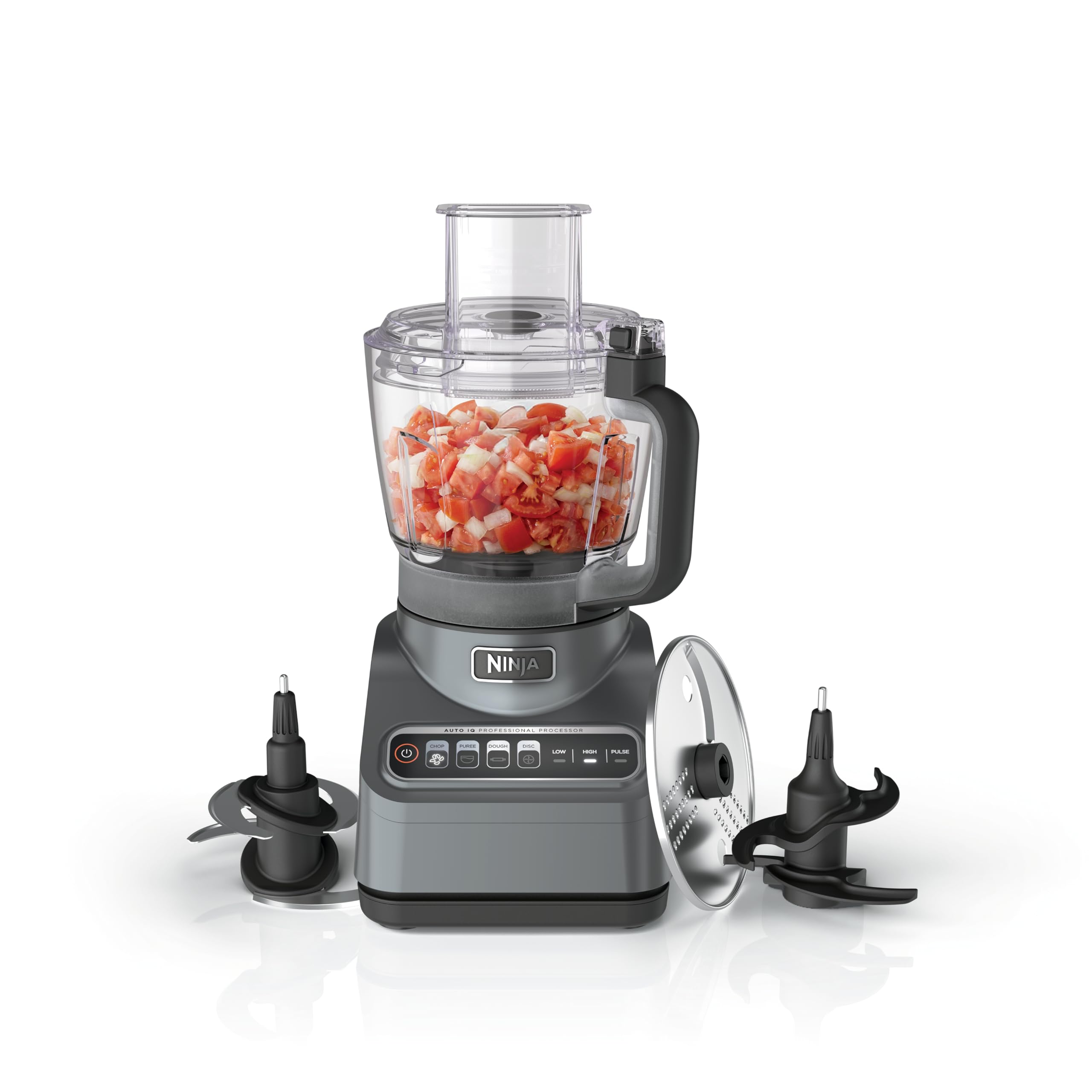
Ninja Professional Plus BN601
See on Amazon
Cuisinart Custom 14 DFP-14BCNY food processor
See on Amazon
Hamilton Beach 70730 food processor
See on AmazonModel comparison
| Model | Price | Rating | Voltage | Weight | Bowl capacity | Best for | |
|---|---|---|---|---|---|---|---|
| | Ninja Professional Plus BN601 | $99.99 as of 10/31 See on Amazon | ★ 4.6 (14,400+ ratings) | 120 V | 7.7 lb | 9 cups | Two-to-four-person households wanting one-button chopping get four Auto-IQ programs and a full disc set in a 9-cup bowl. |
| | Cuisinart Custom 14 DFP-14BCNY food processor | $249.99 as of 10/31 See on Amazon | ★ 4.5 (15,300+ ratings) | 120 V | 18 lb | not stated | Family cooks who work from scratch get a 14-cup bowl, two-button control and a 5-year motor warranty in a planted 18-pound base. |
| | Hamilton Beach 70730 food processor | $69.95 as of 10/31 See on Amazon | ★ 4.5 (41,400+ ratings) | 120 V | 6.2 lb | 10 cups | Budget shoppers doing everyday prep get a built-in bowl scraper that wipes the wall on sticky jobs, plus a 10-cup bowl. |
 | Cuisinart Pro Custom 11 DLC-8SY | $199.95 as of 10/31 See on Amazon | ★ 4.5 (1,000+ ratings) | 120 V | 16.2 lb | not stated | Smaller households wanting full-size build get an 11-cup bowl, a 16.2-pound base and a 5-year motor warranty in a 7-inch-deep footprint. |
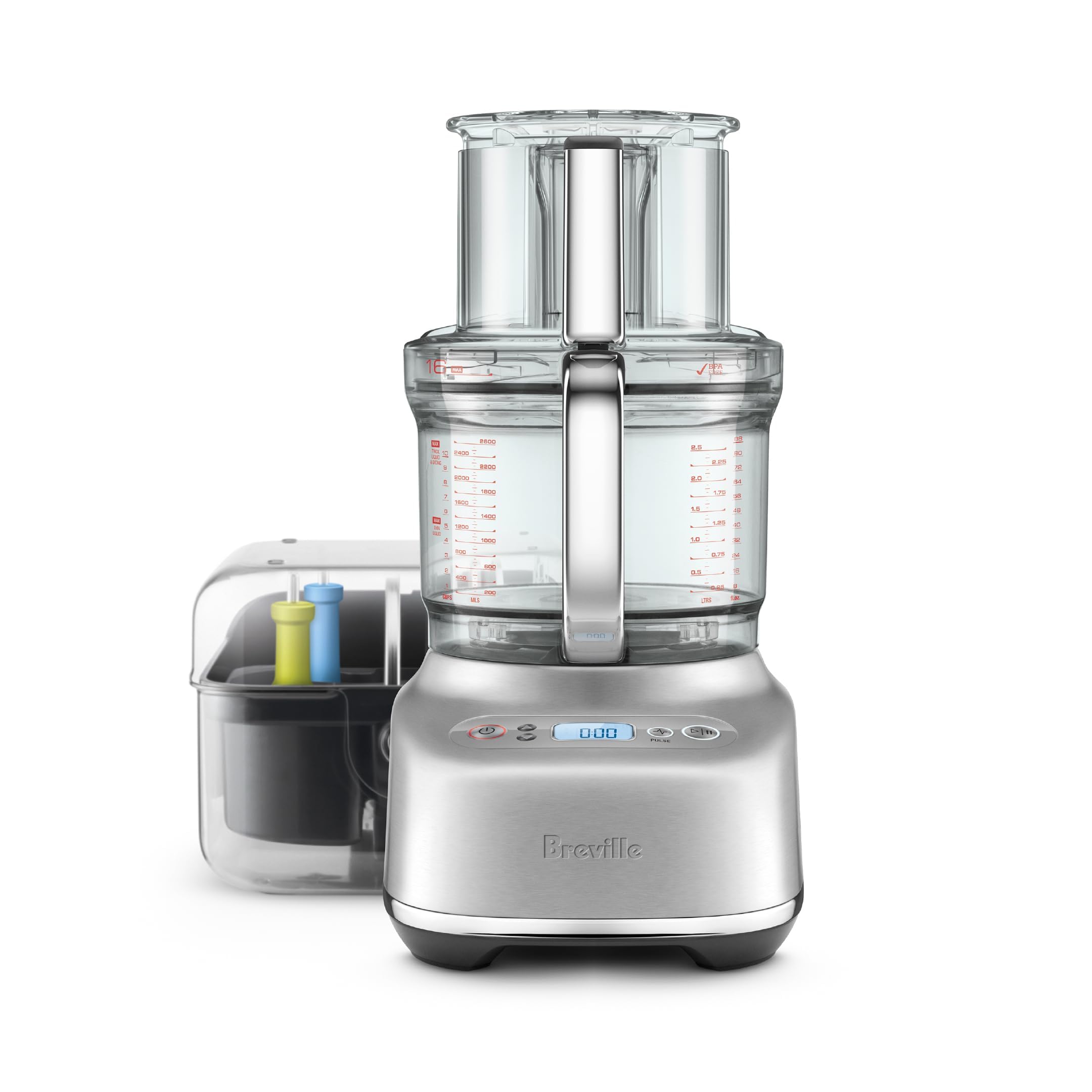 | Breville BFP810 Sous Chef 16 | $499.95 as of 10/31 See on Amazon | ★ 4.6 (150+ ratings) | 120 V | 30.6 lb | 16 cups | Bakers and batch cooks with counter space get a 1450-watt induction motor, a 16-cup bowl and a 24-size adjustable slicer. |
Bowl capacity, stated cups versus what you can actually process
The number on the box is the bowl's brim volume. Usable working capacity is roughly two-thirds of it, because food needs room to tumble over the blade. A 14-cup bowl processes about 9 to 10 cups of solid food before chopping turns uneven; a 9-cup bowl handles about 6.
Match the bowl to your household
- One or two people: 9 to 11 cups is plenty, and a big bowl processes small batches poorly.
- Three or four: 11 to 14 cups covers a meal's worth of prep in one go.
- Five or more, or batch cooking and freezing: 14 to 16 cups saves you from working in rounds.
Why small batches fail in big bowls
In an oversized bowl, a small batch sits below the blade's reach. The blade spins above the food and throws what it touches to the wall instead of circulating it, so you get a puddle of onion under the blade and chunks around the rim. If most of your batches are small, a smaller bowl does the job better.
The counter-argument to bigger is always better
A 16-cup machine is taller and heavier than a 14-cup one, and a bowl you dread lifting is a bowl you stop using. Height is the number to check: a machine around 14.8 inches tall clears most upper cabinets, while one at 17.7 inches may not. Measure the gap above your counter before you buy.
Mini bowls and nested inserts
A mini bowl that nests inside the main one lets you chop a handful of herbs or a single garlic clove in a big machine. It is a real convenience, but it does not fix a machine that is simply too large for the way you cook. If nearly every batch is small, buy the smaller machine.
Liquid capacity, the number that decides whether you'll love it or curse it
Liquid max is a separate and much lower limit than bowl capacity. The spinning blade throws liquid up the bowl wall, so a bowl that holds 14 cups of carrots may hold only a third to a half of that in soup. It is the single most common cause of leaks and one-star reviews.
What it means in practice
Soups, batters, pancake mix, mayo and smoothie-style purees are batch-by-batch jobs on most machines. If you puree soup every week, liquid max matters more to you than bowl size. A large bowl with a small liquid limit is a large bowl you cannot fill with the thing you make most.
How to read the limit
Look for a marked max line inside the bowl. A clearly molded line beats a faint printed one you have to hunt for. Never fill to the brim with liquid, and never process hot liquid: steam pressurizes the bowl and can eject through the lid, and the heat can distort the seals.
Why the biggest bowl is not the biggest liquid holder
A tall, narrow bowl with a low blade can hold more liquid than a wide, shallow bowl of the same stated volume, and the largest bowl does not automatically have the largest liquid capacity.
What the wattage figure on the box really tells you about how your food processor will perform
Wattage describes electricity drawn, not work delivered. Two machines with the same number can behave completely differently under a heavy load, which is why a higher watt figure is not automatically the better machine.
What actually matters
Torque at low speed is what kneads dough and grinds nuts without stalling. Motor type matters just as much. Universal motors are cheap, loud and run hot. Induction motors are quieter, cooler and hold their speed better under load. An induction motor is a fact of a machine's spec, not a rule that every expensive machine is induction.
The practical check
Ask whether the machine keeps its speed when the bowl is full of stiff dough, or whether it bogs down and smells hot. Many machines have a thermal cutout that stops them after a few minutes of continuous running and needs a cooldown, so a dough session is stop-and-go rather than one long run.
Peak versus continuous ratings
A peak-watt figure is a momentary maximum, not what the motor sustains. When a spec sheet says peak, read it as peak. A 1,000 peak-watt motor and a 720-watt motor are not as far apart as the numbers suggest.
Choose the motor by your hardest task
Chopping and slicing are easy work. Dough, nut butter and hard cheese are the load checks. If you never knead or grind, a modest motor is fine. If you do, buy headroom.
What you'll ask it to do, and which spec that stresses
Every task leans on a different part of the machine, and the spec that matters changes with it.
Chop and mince
Blade design and pulse responsiveness decide the result. A pulse that stops the instant you release it gives you control. One that runs on for seconds turns carrots to mush while the celery is still chunky.
Slice and shred
The disc and the feed tube matter more than the motor. Fixed 0.16 in (4 mm) discs are fine for most cooking. Adjustable slicers earn their keep for chips, gratins and coleslaw at different thicknesses. A feed tube needs to be wide enough for a whole potato or a block of cheese and narrow enough to hold a carrot upright, and a 3-in-1 chute covers both.
Emulsify mayo and dressings
This needs a blade that reaches the bowl bottom and a drizzle hole in the pusher. It is where many machines quietly fail, leaving a pool of oil on top of an unbroken yolk.
Knead dough
A metal S-blade kneads as well as a dedicated dough blade on most machines, so the dough blade is a convenience, not a requirement. The realistic ceiling is about a double batch of bread dough in a 14-cup machine. Smaller machines stall.
Puree and grind
A processor purees coarser than a blender by design, so do not buy one expecting blender-smooth soup. Nuts and hard cheese grind well. Coffee and spices do not: they dull and pit the blade.
How the buttons and programs on your food processor change the way you cook
On, off and pulse is enough for most cooks, and a good pulse is worth more than five speeds. A good pulse starts instantly, runs exactly as long as you hold it and stops the moment you let go, so you can count pulses and watch the bowl.
Preset programs for chop, mix, dough and puree trade control for consistency. They are good for repeatable results and less good when you want to stop mid-chop and look. Manual versus programmable is also a price marker: the simplest controls sit at the low end, and program panels sit higher up.
Footprint, weight and where it lives
A processor that slides across the counter during dough is dangerous, and a heavy base fixes that. But heavy also means you will not lift it in and out of a cupboard, so decide up front whether it lives on the counter or gets stored.
Height is the underrated number. Measure the gap under your upper cabinets before buying a large machine, because a tall one that does not fit ends up in a box. Suction feet hold the machine still but make it annoying to move, which is a trade-off rather than a pure win.
Cleaning, and the parts that shouldn't see the dishwasher
Bowls, lids, discs and pushers are typically dishwasher safe. The motor base never is. The chopping blade should be washed by hand, because dishwasher heat and detergent dull the edge and cloud plastic bowls over time.
Design decides cleanup. A bowl scraper, a smooth-sided bowl and few crevices in the lid save minutes every time. Machines with fiddly lids and deep blade housings get left in the cupboard. Wash promptly, too: dried-on dough around the spindle seal is how liquid eventually gets into the base.
Build, warranty and how long it should last
Warranties usually cover the whole unit for a few years and the motor for longer, and the motor warranty is the meaningful part because the motor is what fails. A 3-year unit warranty with a 5-year motor warranty tells you where the maker put the money.
Build signals to check: metal where the bowl meets the base, a metal disc stem, a bowl that survives being dropped and a sealed spindle. Most failures are motor burnout from overloading or liquid getting into the base, not blade wear. That loops back to buying the right motor for your hardest task and never overfilling liquids.
When one machine should also cook
A heated all-in-one processor is a food processor bowl on a heated base, with guided recipes on a screen. It chops, cooks, steams, kneads and blends in one vessel, and some models let you pull the blade mid-cook so a stew does not turn into puree.
What it buys you is counter space and burners, not raw performance. It will not out-chop a 16-cup machine or out-blend a blender, and its searing surface is small. Check whether the blade comes out during cooking, whether the bowl volume fits the batches you cook, whether the recipes need a paid subscription and how long the warranty runs. It suits small kitchens replacing a processor, a blender and a pot. It does not suit anyone whose priority is chopping power or crisp searing.
Processor, chopper, blender or combo
A chopper is a small bowl with one blade. It is fine for onions and herbs, but it has no discs and no dough capability. A blender wins on liquid and smoothness, while a processor wins on solids, slicing and dough. A processor cannot make a smooth smoothie.
Combos and blender attachments are only worth it if you already own the blender base they attach to. Never buy a blender in order to get the processor attachment. A mini processor is worth it alongside a full-size machine for small batches, not as a replacement for one.
Getting Your Machine Set Up and Running Without Risk
Every full-size food processor is built around the same safety logic: the machine will not spin unless the bowl, the blade or disc, and the lid are all seated in the right order. Learn that order once and assembly becomes a five-second habit. Get it wrong and you will either stand there pressing a button that does nothing or, worse, force a part that was never meant to move.
How the parts lock together
Work from the base up, always in this sequence:
- Bowl onto the base. Most bowls drop on and then twist a quarter turn clockwise until they stop. Some click; some have a handle that must line up with a mark on the base. If the bowl rocks at all, it is not seated.
- Blade or disc onto the shaft. The metal S-blade slides down the central spindle and settles at the bottom of the bowl. It should drop freely and sit flat. If it wobbles or rides high, you have it upside down or on the wrong spindle step. Slicing and shredding discs sit on a taller stem, and the cutting side must face the direction the food will travel.
- Lid onto the bowl. The lid locks with a twist or a latch, and the feed tube should end up at the front where you can reach it. Many lids also have a smaller pusher inside the wide pusher, and both need to be in place before the machine will run.
Before you plug anything in, do a gentle tug check on the lid and the bowl. Neither should lift. Then press the pulse button for half a second with nothing in the bowl. If the machine hums and stops, you are assembled correctly. If nothing happens, take it apart and start again rather than pushing harder.
What the safety interlocks actually check
The interlock is a small switch or set of switches that only closes when every part is in its locked position. Depending on the model, it verifies one or more of the following:
- The bowl is twisted fully onto the base.
- The lid is locked onto the bowl, not just resting on it.
- The large feed tube pusher is inserted.
- On some machines, the bowl handle is aligned with a specific mark.
This is why a processor that ran fine yesterday can seem dead today: a lid that is 90 percent locked is still unlocked as far as the switch is concerned. Never tape, wedge, or otherwise defeat an interlock, and never reach into the feed tube to push food down. That is what the pusher is for, and the interlock exists precisely because hands and spinning blades do not mix.
Checks to make before every use
- Unplug before assembling or disassembling. Do this every time, not just when you are being careful.
- Confirm the blade is fully down. A blade sitting on the spindle shoulder instead of the bottom will grind against the lid or leave a gap that lets food escape.
- Check the liquid maximum line. Centrifugal force pushes liquid up the bowl wall while the machine runs, so a bowl filled to the top before you start will overflow. Stay at or below the marked line, and remember that the line is lower than the bowl's actual rim.
- Cut food to fit the feed tube. Oversized pieces jam the pusher and force you to press hard, which is exactly when people start improvising.
- Keep the base dry. Wipe the base and the outside of the bowl with a damp cloth. Never submerge the base or run it under the tap, and make sure the underside of the bowl and the spindle area are dry before you reassemble, since moisture there can trip the interlock or corrode the contacts.
Disassembly and cleaning order
Unplug first, then reverse the assembly: unlock and lift the lid, lift out the blade or disc by its plastic hub (never by the cutting edge), then twist the bowl off the base. Wash the bowl, lid, pusher, and discs in warm soapy water, and hand wash the blade. Dishwasher heat and detergent dull the blade edge and cloud clear plastic over time, so keep the blade out of the machine even if the manufacturer says it is safe. Let everything air dry completely before you stack it back together, because a damp interlock is a common reason a processor refuses to start the next morning.
If the machine still will not run after a full reassembly, check the power outlet and the cord before assuming a fault, then consult the manual for your specific model. Interlock designs vary, so check your manual for which part has to click where.
Safety around blades and hot liquids
A food processor is one of the few kitchen appliances that combines a fast-spinning blade with a motor strong enough to keep going after something goes wrong. Most injuries happen in a few predictable ways, and all of them are avoidable once you know what to watch for.
Handling the blade
- Treat the S-blade as a knife, not an accessory. The center stem and the curved edges cut in both directions. Pick it up by the plastic hub, never by the metal wings, and set it down flat on the counter rather than standing it in a sink full of water.
- Never leave the blade loose in the bowl when the machine is unplugged and unattended. Someone reaching into the bowl for a stray piece of food will find it first. Store the blade in its own holder or in the bowl with the lid locked on.
- Keep the blade out of the dishwasher. Beyond dulling the edge, a wet blade rattling against other items is a handling hazard when you unload. Wash it by hand with a long-handled brush, holding it flat against the bottom of the sink.
- Watch the discs too. Slicing and shredding discs have sharp edges on the underside and around the feed opening. Change them with dry hands and keep your fingers out of the feed tube opening on the disc itself.
Never reach into the bowl while it is plugged in
- Unplug before you scrape. The lid interlock is a safety feature, not a guarantee. Interlocks can be defeated by a cracked lid, a worn tab, or a bowl that is not fully seated, and a machine that starts unexpectedly with your hand inside is the worst-case scenario.
- Use a spatula, never your fingers, to push food down or scrape the sides. Do this only with the machine off and unplugged.
- Keep the feed tube pusher in place. Never use a spoon handle, knife, or your hand to force food down the tube. If a piece will not fit, cut it smaller.
- Wait for the blade to stop completely before removing the lid. Some motors coast for a second or two after you release the button.
- Keep the cord out of reach of children and unplug the machine when you are done, especially in a household with young kids or pets.
Hot liquids are the biggest hidden risk
Processing hot liquid is the most common cause of serious burns from a food processor, and the danger is not obvious. A sealed lid turns the bowl into a pressure vessel, and steam expands fast. The result can be a geyser of near-boiling liquid through the feed tube or a lid that blows off.
- Let hot food cool before processing. Wait until soups, sauces, and purees stop steaming, ideally to below a simmer, before they go in the bowl.
- Never fill past the maximum liquid line, and fill well below it for anything warm. Centrifugal force pushes liquid up the sides even when the bowl looks half empty.
- Leave the feed tube open and uncovered when processing anything warm, and start on the lowest speed or pulse in short bursts. This gives steam somewhere to escape.
- Do not process hot oil or hot fat. Oil at frying temperature can splash and burn, and it can damage plastic bowls and lids.
- Hold the lid down with a folded towel if you must process something warm, and keep your face and arms back from the feed tube.
- Blend in batches. Two small batches are safer than one full bowl, and they process more evenly.
Safety features worth checking before you buy
- A clearly marked liquid maximum line on the bowl, visible from the outside. If the line is faint or missing, treat the bowl as smaller than it claims.
- A feed tube with a wide mouth and a snug pusher. A tube that is too narrow tempts you to improvise with a utensil.
- A lid that locks with an audible click and a bowl that seats firmly on the base. A wobbly bowl is a sign the interlock may not engage reliably.
- A blade that sits close to the bowl wall. A smaller gap means less food stuck to the sides, which means less scraping and less reaching in.
- A stable, heavy base. A machine that walks across the counter while running is more likely to be grabbed at the wrong moment.
None of this makes a food processor unsafe to own. It makes the difference between a tool you use confidently and one that surprises you. When in doubt, unplug it, wait for the blade to stop, and use a spatula.
What Bowl Size and Motor Do for the Sound of Your Machine
Food processors are loud because of how they work, not because of a defect. A motor spinning a blade at high speed through dense food, plus the air and vibration that come with it, produces sound you cannot design away entirely. What you can do is understand which design choices make one machine noticeably quieter than another, so noise becomes a factor you weigh instead of a surprise you discover on the first morning you make hummus.
Why they are loud by nature
The motor itself generates mechanical and electrical noise as it turns. The blade hits food and the bowl amplifies the result, acting a bit like a drum. And the base transmits vibration into your countertop, which can turn a solid surface into a sounding board. A machine that feels rough and rattly is usually losing energy to vibration rather than putting it into the food, and that lost energy is what you hear.
What actually makes one quieter
- Motor type. Induction motors run smoother and cooler than universal motors and are generally the quieter design. They also tend to last longer, which is why the quietest machines are often the ones built to be kept for years.
- Base mass and insulation. A heavy base with internal damping absorbs vibration instead of passing it to the counter. Light bases can skitter and buzz, especially on thin countertops or butcher block.
- Fit and tolerance. A lid and bowl that lock down tightly with no play rattle less. Loose seams and wobbly feed tubes buzz under load.
- Speed control. A machine that lets you start slow and ramp up is quieter in practice than one that slams on at full speed, because most of the worst noise happens in the first second.
- How hard the motor works. A motor straining against a full bowl gets louder and higher pitched. Matching motor strength to the bowl size and the jobs you do keeps it out of that strained range.
Quiet-machine checklist
What you can do is look for the design signals above and, where possible, hear the machine in person.
- Ask whether the motor is induction or universal. It is the single biggest clue.
- Lift the base if you can. Weight here is usually a good sign, not a drawback.
- Check that the bowl and lid lock with a firm, snug action and that the feed tube sits tight.
- Look for a slow-start or variable-speed control rather than only on and pulse.
- Read owner comments for words like rattle, screech, or vibration, and note whether they come from people running it near its capacity.
- Plan where it will live. Running it on a thick mat or a lower-traffic spot in the kitchen does more for your ears than most features will.
Setting realistic expectations
Even the quietest food processor is louder than a blender on low and much louder than a kettle. If noise is a real constraint in your home, such as a small apartment, a sleeping child, or an early schedule, weigh it alongside bowl size and motor strength rather than after them. A machine that is slightly less powerful but smooth and well damped will bother you less day to day than a loud one that chops a few seconds faster. For the jobs where you only need a small amount, a compact chopper runs shorter and quieter and may be the better fit than firing up a full-size machine.
Bowl and body materials compared
Bowl and body material affects how long the machine lasts, how heavy it feels to lift, whether it picks up stains and smells, and what touches your food. Most machines mix materials: a plastic or metal body with a bowl in plastic, glass, or stainless steel. Check each part separately before you buy.
Plastic is light and cheap but prone to wear
Plastic is the most common bowl material because it is light, cheap to mold into complex shapes, and does not shatter if dropped. The trade-offs show up over time.
- Durability: Resists dents and drops but scratches. Scratches trap residue and make the bowl look cloudy after a few years of washing.
- Weight: The lightest option, which matters most on large-capacity bowls you lift full of dough or soup.
- Staining: Tomato sauce, turmeric, carrot, and beet juice can leave a permanent tint, especially in cheaper plastic with a rough interior finish.
- Odor retention: Plastic absorbs strong smells like garlic, onion, and fish. A baking soda soak helps but does not always clear it.
- Food contact: Look for a bowl labeled BPA-free and dishwasher-safe. Heat and harsh detergents speed up wear, so hand washing extends life.
Glass bowls
Glass is heavier and less common, usually found on compact choppers and some mid-size processors. It is the easiest material to keep clean and the easiest to inspect.
- Durability: Does not scratch or stain, but chips and cracks if knocked against a counter or dropped. A chipped rim is a replacement, not a repair.
- Weight: Noticeably heavier than plastic at the same capacity, and the difference grows with bowl size.
- Staining and odor: Neither. Glass does not absorb color or smell, which makes it the best choice if you process garlic, fish, or spice pastes often.
- Food contact: Chemically inert, so nothing leaches into food. Check that the bowl is labeled tempered or borosilicate and dishwasher-safe.
- Visibility: You can watch texture as it forms, which helps you stop before over-processing.
Stainless steel bowls and bodies
Stainless steel appears on premium machines, usually as the bowl with a metal or plastic body. It is the most durable bowl material but comes with its own quirks.
- Durability: Resists dents, scratches, and drops far better than plastic or glass. It will outlast the motor in most cases.
- Weight: Heavier than plastic, similar to or slightly lighter than glass at the same capacity.
- Staining and odor: Neither, as long as the steel is a quality grade. Low-grade steel can pit or discolor with acidic foods over time.
- Food contact: Check for a food-grade stainless grade such as 304. Avoid unlined aluminum bowls, which react with acidic ingredients and can impart a metallic taste.
- Visibility: Opaque, so you rely on the feed tube and lid window to judge texture.
Material checks that matter
- The body, bowl, lid, and feed tube can all differ. A metal body with a plastic bowl is common and fine.
- Confirm dishwasher guidance. Many plastic bowls are top-rack only, and blades should be hand washed regardless of bowl material to keep the edge sharp.
- Weigh the lifting. If you regularly lift a full bowl, a lighter plastic bowl offsets a heavy base. If you mostly chop and shred, bowl weight matters less.
- Match material to your cooking. Glass or steel suits cooks who process staining or pungent ingredients. Plastic suits buyers who want the lightest bowl and will replace the machine sooner.
- Check replacement parts. Bowls crack and lids warp. Confirm you can buy a replacement bowl and lid for the model you choose.
For most US kitchens, a plastic bowl on a sturdy base is the practical default, and glass or stainless steel is worth the extra weight if staining, odor, or food-contact concerns are your priority.
Our picks by budget
The Hamilton Beach 70730 is our budget pick because it delivers the full set of basic functions, chopping, slicing, shredding and pureeing, plus a bowl scraper that keeps food moving toward the blade. What you give up is motor headroom on dough and nut butter, quietness and stability.
The Cuisinart Pro Custom 11 DLC-8SY is our mid-range pick because the 16.2-pound base and extra-large feed tube are the visible upgrades: the machine stops feeling like an appliance and starts feeling like a tool. The 625-watt motor and 11-cup bowl cover a family's daily prep.
The Breville BFP810 Sous Chef 16 is our premium pick because the premium buys motor type, disc range and feed-tube flexibility, the three things that decide how much of the machine you actually use. The induction motor, 24-setting slicer and 3-in-1 chute are what you are paying for.
Budget
Mid-range
High-end
Which food processor fits how you cook
Household size and the hardest task you attempt decide more than any single spec.
Cooking for one or two on a budget
A 10-cup bowl is right-sized for small batches, the bowl scraper saves scraping, and the discs cover everyday prep. The 450-watt motor suits chopping and shredding, not dough.
Want preset programs without the premium
Four Auto-iQ programs and three blades do the timing for you, and the 9-cup bowl suits a smaller household. It is lighter than the Cuisinart DFP-14BCNY 14-Cup food processor, the Cuisinart Pro Custom 11 DLC-8SY, and the Breville BFP810 Sous Chef 16 at 7.7 pounds.
Three or four people, one machine to last
The 11-cup bowl and 16.2-pound base are the balance point, and the extra-large feed tube takes whole fruits and vegetables. The split motor warranty reflects where the money went.
The default large-bowl buyer
14 cups and a 720-watt motor cover chopping, slicing, shredding and light kneading, with two buttons. It fits under standard cabinets at 14.8 inches tall.
Serious cook, bread and batch cooking
The 16-cup bowl, induction motor, 24-setting slicer and 3-in-1 chute are the reasons to pay. It is the heaviest and tallest machine here, so plan counter space for it.
Our verdict on the best food processor
The Cuisinart DFP-14BCNY is the overall pick because its bowl size and motor best fit the most households: 14 cups, a 720-watt motor, the simplest possible controls and the longest unit warranty here. The Hamilton Beach 70730 is the value pick for small households, the Breville BFP810 is the premium pick for batch cooks and bakers, the Ninja BN601 is the program pick, and the Cuisinart DLC-8SY is the compact-large-bowl pick. Buy the bowl for the batch you cook most often, and the motor for the hardest thing you'll ask it to do.
Detailed model analysis
Bowl size and motor power pull in opposite directions, and the right machine is the one where they meet your cooking.
Ninja Professional Plus BN601
The Ninja Professional Plus BN601 suits you if you would rather press a button than pick a speed. Four Auto-iQ programs handle chopping, slicing, pureeing and dough making, so the machine sets the pace for you.
The motor is rated at 1,000 peak watts and the bowl holds 9 cups. You get three blades: a chopping blade, a dough blade and a reversible slicing and shredding disc, plus a feed chute lid with a pusher.
It weighs 7.7 lb. Removable parts are BPA-free and dishwasher safe, and a safety interlock stops it from running unless it is assembled properly.
The main limit is the 9-cup bowl. Cooks who prep for a crowd will find it small next to the 14-cup Cuisinart Custom 14 DFP-14BCNY or the 16-cup Breville BFP810 Sous Chef 16.
Read the 1,000 watts as a peak rating, a top-end number. It suits cooks who chop and puree often and want a light machine that handles the timing.
- Brand: Ninja
- Peak power: 1000 W
- Bowl capacity: 9 cups
- Voltage: 120 V
- Weight: 7.7 lb
- Dimensions: 7.76 in deep, 9.88 in wide and 16.02 in high
Cuisinart Custom 14 DFP-14BCNY food processor
The Cuisinart Custom 14 DFP-14BCNY is a classic large-bowl machine. Its 14-cup bowl holds plenty of chopped vegetables, shredded cheese or dough in one go.
Controls are simple: an On button and an Off/Pulse button. It runs at one speed plus pulse, so there is nothing to set. The 720-watt motor handles chopping, shredding, slicing and kneading.
It includes a 4 mm stainless steel slicing disc, a medium shredding disc and a stainless steel chopping and mixing blade. The extra-large feed tube takes both small and large pushers. It also mixes, emulsifies and minces.
A detachable disc stem and dishwasher-safe parts make cleanup easier. The 36-inch cord gives you room to place it. The motor has a 5-year full warranty, and the whole unit has a limited 3-year warranty.
The discs are not adjustable, so slicing thickness is fixed at 4 mm. The Breville BFP810 Sous Chef 16 offers 24 slicing sizes. It is also big, at 18 lb.
It suits family cooks who work from scratch and want a roomy bowl with simple controls.
- Brand: Cuisinart
- Capacity: 14 cups
- Power: 720 W
- Voltage: 120 V
- Dimensions: 11 in deep, 7.9 in wide and 14.8 in high
- Weight: 18 lb
Hamilton Beach 70730 food processor
The Hamilton Beach 70730 stands out for its built-in bowl scraper. You move it side to side to wipe the bowl wall, with the processor running or off and the lid on. That helps with sticky or thick mixes.
The bowl holds 10 cups, more than the 9-cup Ninja Professional Plus BN601 but less than the 11-cup Cuisinart Pro Custom 11 DLC-8SY. The large feed chute cuts down on pre-chopping.
The motor is rated at 450 watts. It has low, high and pulse settings, and it is meant for jobs like carrots, Parmesan, salads, salsa and acai bowls.
It covers five functions: slice, shred, chop, mix and puree, with a chopping blade, a slicing disc and a shredding disc. There is no dough blade, so bread dough is not what it is built around.
It weighs 6.2 lb, lighter than the Ninja at 7.7 lb. Parts are BPA-free in all food zones, and a 1-year limited warranty covers it.
It suits budget shoppers doing everyday prep who want a 10-cup bowl and a scraper in place of a spatula.
- Brand: Hamilton Beach
- Bowl capacity: 10 cups
- Power: 450 W
- Voltage: 120 V
- Speeds: 2 plus pulse
- Weight: 6.2 lb
Cuisinart Pro Custom 11 DLC-8SY
The Cuisinart Pro Custom 11 DLC-8SY pairs an 11-cup bowl with a 625-watt motor in a small footprint.
The extra-large feed tube takes whole fruits and vegetables, so you cut less before processing. Small and large pushers fit it.
You get a chopping, mixing and dough blade, a stainless steel medium shredding disc, a 4 mm medium slicing disc, a detachable disc stem and a spatula.
It chops, slices, shreds and purees, with simple on/off-pulse controls. The parts are dishwasher safe and BPA free. It weighs 16.2 lb.
The limits: the bowl is smaller than the 14-cup bowl on the Cuisinart Custom 14 DFP-14BCNY, the body is plastic where it and the Breville BFP810 Sous Chef 16 are stainless steel, and extra accessories are sold separately.
It suits cooks with limited counter depth who still want a full-size feed tube and an 11-cup bowl.
- Brand: Cuisinart
- Power: 625 W
- Capacity: 11 cups
- Voltage: 120 V
- Dimensions: 7 in deep, 11.25 in wide and 14.5 in high
- Weight: 16.2 lb
Breville BFP810 Sous Chef 16
The Breville BFP810 Sous Chef 16 is built for batch cooks and bakers. Its 16-cup bowl is 2 cups more than the Cuisinart Custom 14 DFP-14BCNY and 7 more than the Ninja Professional Plus BN601.
A 1450-watt induction motor drives it directly, and the motor carries a 30-year warranty. It runs at one speed only.
Slicing is where it stands out. The adjustable disc offers 24 sizes, while the Cuisinart Custom 14 DFP-14BCNY slices at a fixed 4 mm. The 3-in-1 feed chute spans 1.7 in to 5.5 in.
You get a micro-serrated S-blade, a dough blade, a reversible shredding disc and a French fries disc. A mini bowl and mini blade handle small jobs, and a storage container keeps attachments and cleaning utensils together.
Parts are dishwasher safe and the bowl is BPA free. It is the tallest of the five, so you need counter space and room under cabinets.
It suits bakers and batch cooks who want a 16-cup bowl and precise slicing.
- Brand: Breville
- Bowl capacity: 16 cups
- Motor power: 1450 W
- Voltage: 120 V
- Weight: 30.6 lb
- Dimensions: 9.2 in deep, 11.3 in wide and 17.7 in high
Frequently asked questions
Bowl size, liquid limits and motor headroom answer most of what buyers get stuck on.
Does wattage matter?
Less than the box suggests. Torque under load and motor type matter more. If you knead dough or grind nuts, look for a motor that holds its speed in a full bowl and a warranty that covers the motor for several years.
What's the difference between bowl capacity and liquid capacity?
Liquid max is the marked line inside the bowl, and it is always well below the brim. On a 14-cup bowl it typically works out to roughly 5 to 7 cups, so a soup recipe that looks like it fits will not. Stay at or below the line, and let anything hot cool below a simmer before it goes in.
Will a large food processor handle a small batch of onions or herbs well?
Often not. A small batch needs enough food to reach the blade and keep moving, so a bowl rated for 14 cups handles a single onion poorly. Aim for a bowl that holds no more than about three times the volume you usually process, and keep a nested mini bowl for handfuls of herbs or a single clove.
How much bread dough can you knead in a 14-cup food processor?
Plan on a minimum of 720 watts and a 14-cup bowl for a double batch, and treat that as the limit rather than a starting point. A double batch means roughly 6 to 8 cups of flour, and anything beyond that belongs in a stand mixer. If you bake bread weekly, buy headroom in the motor, because dough is one of the load checks that separates a strong machine from a modest one.
Should you leave your food processor on the counter or store it in a cupboard?
Weigh the base against your storage plan before you commit. A machine that stays put during dough is worth having, but check the weight against how often you would move it. A heavy base keeps the machine from sliding across the counter during dough, but that same weight means you will not lift it in and out of a cupboard. Decide before you buy, and if it stays out, leave at least 18 inches of clearance above the counter so a tall machine still fits.